Main

July 21, 2008

No, No, Naf Naf

Isabel Marant Fall 2006According to a French court, the cheap chic chain Naf Naf's copy of an Isabel Morant dress was, well, a bit naff

Despite minor differences between the original puff-sleeved black dress (on the runway, left) and the "slavish" copy, the chain and its supplier, Paris Paris, were ordered to pay the designer 75,000 euros (approx. USD $120,000).  The court also criticized Naf Naf for following in the wake of Isabel Morant's success and attempting to profit from the designer's creative investment without untying its own purse strings.  Both dresses were in stores during the Fall 2006 seasion, with the original priced at 250 euros and the knockoff at only 69.90 euros. 

An unusual decision?  Only in the sense that it actually went to court.  According to Counterfeit Chic's sources, European designers, who enjoy legal protection against such plagiarism, regularly settle similar complaints against fast fashion companies. 

U.S. designers, of course, still lack such legal protections -- at least until the next Congress convenes and the Design Piracy Prohibition Act is reintroduced. 

Via WWD.  Thanks to the indomitable Steven Kolb for the tip!

July 14, 2008

Tiffany Loses Lawsuit against eBay

eBay tumbled Tiffany's carefully stacked legal arguments today, with the court concluding that the jewelry giant must bear the burden of policing its own marks against online counterfeiters.  Opinion here  -- discussion to follow.


Tiffany v. eBay: Today's the Day!

Some people obsessively click "refresh" when trying to buy concert tickets.  Others can't stop returning to Drudge for election news.  For Counterfeit Chic, it's the latest in the world of law & fashion.

On Friday, that electronic docket-stalking finally turned up Judge Richard J. Sullivan's handwritten notice of intent to release his much-anticipated decision in Tiffany v. eBay -- today! 

The auction giant has been battered and bruised in similar cases in France, but will a U.S. court also hold eBay responsible for the sale of counterfeit goods on its site?  We'll keep you posted.  In the meantime, check out WWD's review of the dispute (thanks to Matt Lynch for the quotes!). 

July 11, 2008

Euros and Scents: More on LVMH v. eBay

Time is money in eBay's ongoing battle with LVMH, as a French appellate court upheld a fine of 50,000 euros per day for as long as the auction site continues to allow sales of several LVMH perfume brands.

This ongoing fine is on top of the 38.6 million euros already awarded to LVMH, primarily to compensate for the sale of counterfeit luxury products on eBay, but also as a penalty for the unauthorized sale of authentic fragrances, including scents from Dior, Givenchy, Guerlain, and Kenzo.  Like other luxury companies, LVMH carefully controls the distribution of its fragrances under the theory that a rose does not smell as sweet -- nor does it command as high a price -- when it's sold alongside lesser blooms.  In addition, it's easy for counterfeit versions to creep into unmonitored supply chains -- hence the periodic news stories about fake eau de toilette that turns out to contain, well, just that.  Distribution agreements therefore typically attempt to prohibit resale, with varying degrees of success.

While eBay doesn't defend the sale of counterfeits, it is opposed to legal limitations on e-commerce that limit the resale of authentic products, like the fragrances in question.  According to Bloomberg, however, eBay has now announced its intent to comply with the order "as technically and humanly as possible."  Whatever that might mean.

In the U.S., the first sale doctrine (usually referred to elsewhere as "exhaustion of rights") limits the ability of an intellectual property rights owner to control a product once it has been released into the stream of commerce.  In other words, if you want to resell that copyrighted book you've finished reading or that tacky trademarked tchotchke, go right ahead.  However, copyright and trademark holders have had some success in limiting the first sale doctrine via contract (and statutory modifications), which is why you usually don't buy software -- you just license it, with a prohibition on passing it on.  Other jurisdictions enforce somewhat greater restrictions on resale -- so French LVMH and American eBay are involved in a cultural clash as well as a legal one. 

While LVMH has once again experienced the sweet smell of legal success, its dispute with eBay is far from over -- with respect to either counterfeits or unauthorized sales of authentic products.  Stay tuned.

And in the meantime, read more about the issue in Cosmetic News (thanks to Sophie Douez for the quotes!) or listen to my brief chat with June Grasso on Bloomberg Radio at 4:20 this afternoon.

June 30, 2008

Strike 2: eBay loses to LVMH

The gavel has fallen -- and hit online auctioneer eBay pretty hard.

In a much anticipated decision, a French court today ordered eBay to pay LVMH 38.6 million euros for allowing the sale of counterfeits on its site.  The award is allocated among several divisions of the luxury conglomerate, primarily LVMH and Christian Dior Couture, with smaller amounts to perfume brands Christian Dior, Givenchy, Guerlain, and Kenzo. 

Following on the heels of Hermes' victory against eBay in another French court earlier this month, the decision essentially shifts more of the responsibility for policing offerings to the auction site, which profits from each sale -- counterfeit or not.  After learning of its loss in court, eBay immediately announced its intention to appeal and went on a rhetorical offensive, stating, "Today's decisions are not about fighting counterfeiting. It's about LVMH's desire to protect commercial practices that exclude all competition." 

Obviously the French judges haven't bought eBay's argument -- but will home court advantage help?  Or will the long awaited U.S. decision in Tiffany v. eBay be strike 3 for the auction site?  Stay tuned.

(For background on the case, click here.) 

June 26, 2008

Burberry Orders Heelys to Heel

If you've ever been run over on the sidewalk by a kid who appears to be wearing an innocuous pair of sneakers -- no skateboards, rollerblades, or other wheeled menaces in sight -- then you've encountered Heelys.  The post-millennial generation, it seems, is too busy to stop and change gear in order to shift from walking to gliding.  Hence Heelys, the athletic shoes with an embedded wheel in the heel, allowing the wearer to simply shift his weight back, lift his toes, and roll.  (Or fall over backwards, but that's not really the idea.)

Heelys claims patent protection for the single wheel in the heel, manufacturing methods, and even the proper stance to take when heeling.  And it's not afraid to enforce those patents.

When it comes to others' IP rights, however, Heelys' freewheeling ways may be a bit off-balance.  In a recent complaint, the British luxury brand Burberry claims that Heelys has rolled over its trademark on the iconic Nova Check plaid.  And since one picture is worth a thousand puns, take a look at the evidence:

Might Heelys have simply gone mad for plaid and picked the wrong one?  Not likely, if the not-so-fine print on the box is any indication:

Checkmate.

June 04, 2008

Party Time

Summer's hottest trend is here!  No, it's not gladiator sandals or splashes of superhero-worthy primary color -- it's lawsuits claiming 3rd-party liability for copyright and trademark infringement. 

Today a French court ordered eBay to pay Hermes 20,000 euros after the internet auction site allowed a user to sell 3 Hermes handbags, 2 of which turned out to be counterfeit.  The court's decision is also supposed to appear on eBay's French homepage, but no sign of it yet.  The site does have an extensive anti-counterfeiting page, though.  (Thanks to Counterfeit Chic reader Deb Mason for the tip!)

The ruling in favor of Hermes could be just the tip of the iceberg for eBay's French operations.  20,000 euros may cover a couple of basic Birkins, but, in a separate pending case against eBay, luxury giant LVMH has demanded damages of €20 million.  According to Le Monde, a decision is due by the end of the month.

Meanwhile, on this side of the Atlantic, the U.S. Supreme Court has let stand a 9th Circuit decision in Perfect 10 v. Visa, absolving the credit card company of liability for facilitating sales of infringing goods.  As WWD's Liza Casabona notes, however, questions of contributory and vicarious liability will continue to occupy the legal landscape, with a decision in Tiffany v. eBay still undecided.  (Thanks for the quote, Liza!)

Seems that the lawyers pursuing 3rd-party liability claims on behalf of their fashion clients have come up with not only a legal strategy, but a lifestyle mantra:  After the law shows up at one party, move on to the next.  Not a bad way to spend a hot summer night.

Continue reading "Party Time" »

June 03, 2008

Still More Stripes

If your dazzled retinas keep generating afterimages of adidas' 3-stripe trademark and the USD $305m verdict against Payless, read more from Mark Albright of the St. Petersburg Times (thanks for the quote!) or listen in on my conversation about the case with Scott Drake of the Legal Broadcasting Network.  Trust me -- his radio voice alone is worth a click.

Or, for more fun with stripes, stare at a fixed point on the image below for 30 seconds and then look at a blank wall or page.  Same design, new colors?  Congratulations -- you could have a future in the Payless design department.

May 08, 2008

adidas v. Payless: 3 Stripes, You're Out

Why put on athletic shoes and go for a run when simply reading about adidas' latest victory can raise your heart rate? 

adidas v Payless

In a lawsuit claiming that Payless had engaged in unsportsmanlike conduct with respect to adidas' ubiquitous 3 stripes, an Oregon jury awarded the German athletic wear company USD $305 million, reportedly a record for a trademark infringement case.  And yes, that's over $100m per stripe.  Kansas-based Collective Brands, which owns Payless, intends to challenge the verdict.

The win for adidas comes on the heels of another victory in the European Court of Justice, which recently ruled that a Dutch court could not take into account others' desire to maintain access to a design element as basic as 3 stripes.  The decision was based on the already established link in the public mind between adidas and the 3-stripe design, when used as a trademark (as opposed to a general design element). 

Of course, the adidas stripes weren't always treated as a trademark.  For years, the International Olympic Committee allowed 3-stripe patterns much larger than the usual 20-centimeter limit on athletes' clothing, treating the stripes as simply part of the design.  In response to competitors' objections and in recognition of adidas' worldwide trademark registrations, the IOC changed its position prior to the 2006 Winter Games. 

Interestingly, the verdict sheet in adidas v. Payless shows that the jury found infringement in the case of 2- and 4-stripe models as well.  In fact, among 250+ styles, the jury only disagreed with adidas in one case -- a model that appears to have only 1.5 stripes.  Presumably 5 stripes, the longtime territory of K-Swiss, would be off-limits to Payless as well. 

K-Swiss

But hey, Payless can always base its next collection on lawyers' pinstripes.

April 27, 2008

Copying for Charity

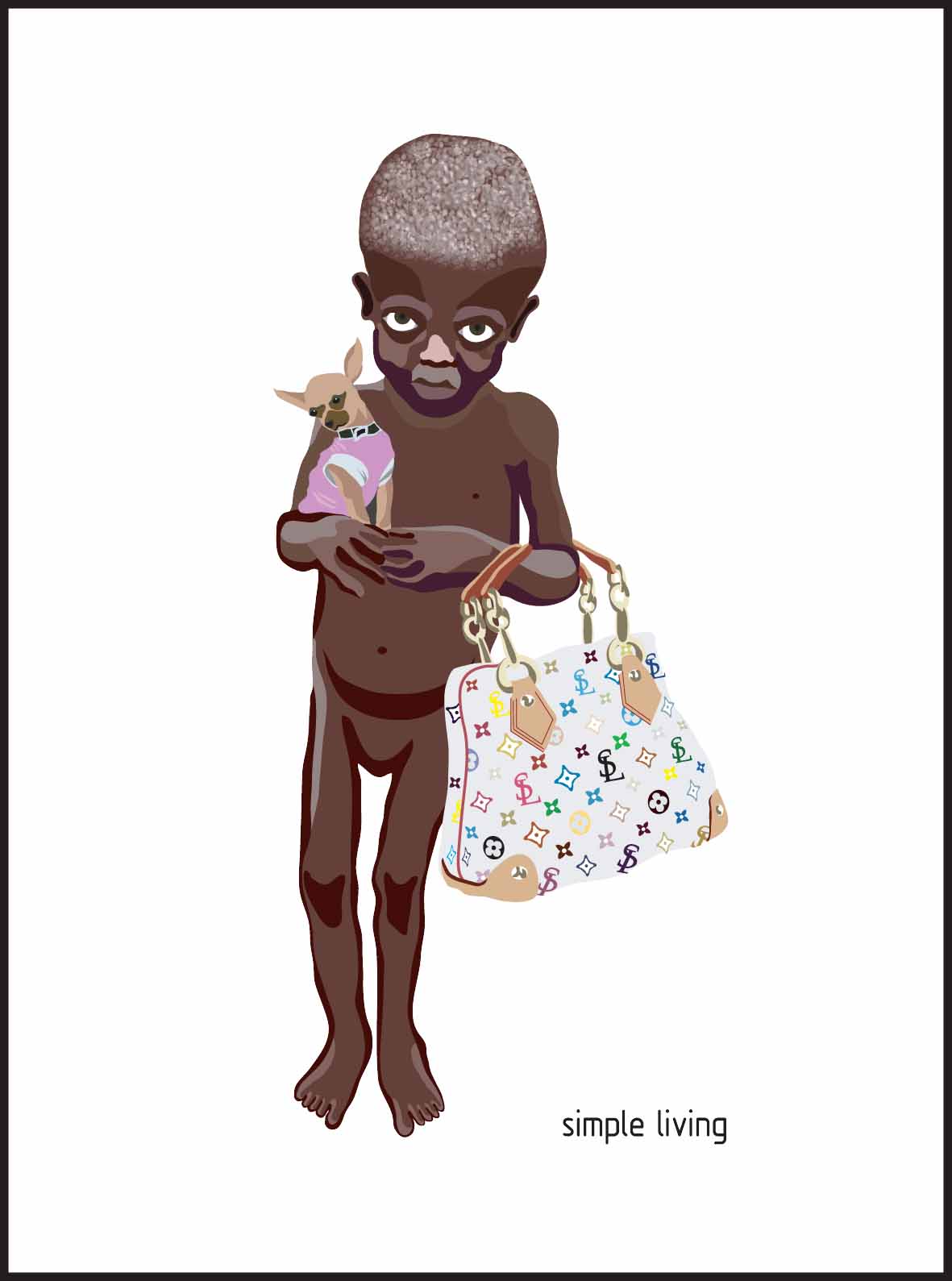
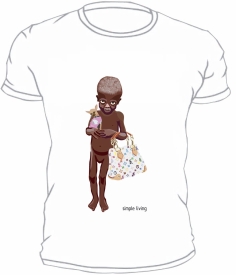
Click for larger imageJudging from my inbox, more than a few of you have heard that Louis Vuitton has sued Danish artist Nadia Plesner over the t-shirt design at left. 

The image casts a Sudanese child from the troubled Darfur region in the role of Paris Hilton, complete with small pink-clad dog and designer handbag, in order to criticize the media's excessive coverage of attention-seeking celebutantes rather than genocidal conflict.  In Nadia's words, "Since doing nothing but wearing designerbags and small ugly dogs appearantly is enough to get you on a magasine cover, maybe it is worth a try for people who actually deserves and needs attention."  (The lack of undergarments may also evoke Ms. Hilton, but the artist doesn't mention her model's unmentionables.) 

The issue for Louis Vuitton, however, is that Nadia didn't just depict any designer bag, but a version of the iconic Multicolore toile pattern, complete with the LV initials morphed into dollar and pound signs.  The company objected to this use as trademark infringement and asked Ms. Plesner to stop selling the t-shirts.  The letter is interesting in itself, since the tone is fairly unusual for a C&D -- "Hey, we're all artists here, and Takashi Murakami and Marc Jacobs collaborated on that bag," rather than the typical demands for an accounting of all units sold, disgorgement of funds, destruction of all remaining merchandise, and the head of the offending party on a platter.  It even offers a nod to Nadia's "Save Darfur" mission.  Still, LV very clearly wanted the shirts depicting its trademarks off the market -- and Nadia responded with a defense of her freedom of expression.  (She also somewhat surprisingly started out by arguing that her drawing refers to designer bags in general and not LV in particular, but more on that in a moment.) 

After Nadia and Louis Vuitton failed to reach an agreement, the company filed the lawsuit that has drawn far more attention than Nadia's initial project.  Without deciding the case, let's take a look at why there's an impasse. 

Q.  Why do Louis Vuitton's lawyers object to the t-shirt?

A.  The simplest answer is that their job is to protect LV's trademarks.  And, legally speaking, they're supposed to object to unauthorized commercial distribution of those marks.  A trademark holder that doesn't enforce its rights can ultimately lose them, as the marks may be considered abandoned or even generic.  Every time you ask for a Kleenex instead of a tissue or make a Xerox instead of a photocopy, a trademark lawyer somewhere gets another grey hair. 

The same is true for the extremely recognizable Multicolore pattern, which has been copied over and over again and is the subject of ongoing litigation between LV and other manufacturers.  It is the responsibility of LV's lawyers to make sure that the public's association between the Multicolore design and the company is not weakened in any way.  Thus Nadia's claim that her design "is inspired by - and refers to - designers bags in general - not a Louis Vuitton bag" is the last statement that would be reassuring or persuasive to a trademark lawyer. 

Q.  But Nadia created the t-shirts for charity -- doesn't that matter?

A.  Yes and no.  We all love a good cause, and we admire people who actually take action when confronted with evil. 

From a trademark lawyer's perspective, however, unauthorized commercial distribution is a threat, whether or not the profits go to a good cause.  Even charities that hold trademarks have problems protecting their marks from other philanthropic parties with similar purposes.  A representative of a prominent health-related nonprofit organization once told my class that she spends much of her time admonishing other groups that have put her organization's logo on their educational literature or their healthy products.  As she put it, "We're a charity, but we're not in the business of giving away our trademark."  Similar issues arise when trademarks are "borrowed" for religious purposes.  Trademark owners who object aren't necessarily grumpy atheists, just concerned about their marks. 

LV's initial letter to Nadia reflects this tension between sympathizing with social concerns and protecting intellectual property -- hence the unusually moderate request and tone for a C&D. 

Q.  So why didn't Louis Vuitton just give Nadia permission to use its trademark?

A.  One strategic option for any company whose trademarks have been used without authorization is to give permission, and also exercise some control, via a licensing agreement. 

Of course, Nadia didn't ask for permission.  And Louis Vuitton may or may not have been willing to grant it if she had, since its marks are constantly copied and copied again.  Also, while Nadia's stated intent was to criticize media attention to celebrities instead of tragedies, her profits from the t-shirts go to Divest for Darfur, an organization that opposes financial investment that ultimately funds genocide.  The presence of LV trademarks on the t-shirt could mistakenly be read to imply that Louis Vuitton had made investments that were helping to fund genocide -- not a message that the company would want broadcast, even in error.  In U.S. legal terms, LV could argue that Nadia was not only engaged in dilution of its well-known marks by blurring (basically overuse by non-owners) but also by tarnishment (negative association).

Q.  What about freedom of expression?

A.  Free speech is an important right, and one that every democratic society protects in different ways.  Intellectual property law establishes exclusive rights in specific expressions, but also attempts to maintain a balance between freedom of expression and creators' rights. 

In other words, at the same time that the law protects trademarks, it creates defenses for those who wish to use them in discussion (like the use of the name "Louis Vuitton" thoughout this post).  Different countries have different trademark laws and thus different defenses to unauthorized use.  In the U.S., the general standard is "fair use," including parody, while other jurisdictions have specific rules about what is or is not allowed in terms of expression.  To complicate matters even further, fair use of a trademark and fair use of copyrighted material are subject to different standards. 

In general, under U.S. law a visual artist is safer using a trademark to comment on or make fun of the trademark owner itself (parody) than to make other social statements (satire).  After all, it may be necessary to make limited use of a trademark to make a statement about its owner, but statements about other things can be made using other vocabulary.  Of course, whether or not something qualifies as parody or other protected speech may require a judicial decision.  Nadia writes that her goal was to make a statement about media coverage, not about Louis Vuitton. 

In her response to Louis Vuitton, Nadia also mentions Zbigniew Libera, a Polish artist who created LEGO concentration camp sets with blocks donated by the Danish company.  In the finished versions of the controversial work, Libera included a statement that his work was sponsored by LEGO.  The company vehemently denied knowlege of exactly what the artist had intended and filed a lawsuit that was later withdrawn.  The story is a cautionary tale for companies who choose to support artists -- whether by donating plastic blocks or the use of their designs -- but is ultimately quite different from Nadia's choice to act unbeknownst to Louis Vuitton. 

Q.  Do you think Paris Hilton will sue Nadia?

A.  Actually, I try not to think about Paris Hilton. 

But if I did, I might wonder whether she would assert a state law right of publicity claim against Nadia, much as she did against Hallmark.  If Vanna White can win her case against Samsung for posing a robot in a blonde wig on a game show set, then Paris could consider suing an artist for selling images of an African child with Hilton-style accessories.  Paris' case would be weaker here, however, since Nadia is criticizing the media for its coverage of Hilton's attention-seeking behavior and perhaps impliedly criticizing Hilton herself, rather than simply selling greeting cards or electronics. 

Q.  How can artists like Nadia avoid lawsuits by trademark holders?

A.  There's a lot of confusion out there as to what artists can and cannot do legally with corporate logos. Unfortunately, the law in this area is not entirely clear, and greater specificity would benefit both trademark holders and artists.  There are, however, some general principles.

For an independent artist, the safest option of all is not to use others' trademarks.  Any such use is a risk, and defending a lawsuit is time-consuming and expensive, even for an artist who ultimately wins.  (Now you know why so few lawyers have become great artists -- we're trained to think about worst-case scenarios.)

That being said, corporations are significant players in modern life, and as a society we need to be able to engage in commentary and criticism, whether that takes the form of op-eds or visual art.  A trademark is shorthand for a corporate entity itself.  The law thus recognizes and protects some critical or discursive use of trademarks. 

Before an artist uses a corporate trademark, she should think about whether or not her intention is to comment on the trademark holder -- and assess the risk according to the relevant national law.  If the use of someone else's trademark is just to make a visual joke or to sell the artist's own products, then that use is lawsuit bait, and the artist may very well be liable for damages.  And by the way, some companies are more determined than others when it comes to enforcing their rights. 

Of course, an artist's intent may be to transgress boudaries and challenge the law, but she should at least figure out where the line is before crossing it. 

Q.  And how should companies respond to unauthorized use of their trademarks by artists?

A.  As we've discussed, trademark holders are required to attempt to assert control over unauthorized uses, lest they lose their trademark rights entirely.  But for most holders of frequently copied trademarks, enforcement is a matter of allocating limited resources -- and managing public relations.  It's impossible to stop every counterfeit handbag seller on every street corner in the world, or to review every art school sketch to determine whether it's fair use.  Commercial sales in large multiples tend to make trademark lawyers see red; a one-off, transformative use may be worth only a shrug and a sigh. 

Q.  Who's going to win this case?

A.  That's a question for a Danish court -- although a settlement is still possible.  In the meantime, don't try this at home. 

Many thanks to Jenny Leugemors and Jayshree Mahtani, the first two to alert Counterfeit Chic to the story!

Via TorrentFreak.

April 22, 2008

The Mother of All Inventions

Katerina Plew claims to have had a less-than-uplifting experience with Victoria's Secret and its "Very Sexy 100-Way Strapless Convertible Bra."   According to a complaint filed yesterday in federal district court, the Long Island paralegal is the real inventor of the bra -- and Victoria's Secret has merely found 100 ways to infringe her patent.

Patent no. 189,672 from 1877While few fashion-related innovations qualify for patent protection, and the process of obtaining a patent is generally too slow and too expensive for those that do, women's foundation garments are among the categories of clothing for which protection has frequently been sought.  A successful new innerwear invention won't be "out" after one season, but will win customers -- and generate profits -- for years.  Thus over the past two centuries, the U.S. Patent Office has kept abreast of new form-fitting and figure-flattering technologies, from corsets to push-up bras.  Check out Theresa Riordan's illustrated history, Inventing Beauty, for more detail.   

If Plew's case goes to trial, Judge Laura Taylor Swain will have to navigate some tricky legal curves.  Counterfeit Chic suspects, however, that there will be no shortage of law clerks offering to review the evidence. 

In the meantime, some enterprising publisher has no doubt commissioned a future bestseller:  100 Ways to Unhook a Very Sexy Convertible Bra

Thanks to Andrew Wolinsky for the tip!

April 17, 2008

Couture in Court 7

For those who prefer briefs to boxers, a periodic collection of fashionable events in the judicial system:

U.S. Polo Association's double horsemen logo

Ralph Lauren's Polo pony

In court, the beauty biz can get ugly:

All that glitters may not be gold:

And maybe it's all the printed flowers springing up this season, but textile manufacturers seem particularly allergic to copyright infringement:

Finally, the most frequently mentioned "couture in court" over the past week was probably not the subject of a lawsuit, but the outfit worn by Harry Potter author J.K. Rowling as the plaintiff and star witness in a copyright action.  The New York Times described her ensemble unusually as a "black dress and pinstriped suit," the New York Post as a brown pinstriped suit accessorized with a charm bracelet of the author's own literary characters, and Portfolio.com as a "simple grey pinstripe suit."  Maybe it's a trick of the light, or maybe Ms. Rowling has cast a confundus charm on the assembled reporters.  But if the evidence in the case is this conflicting, it's no wonder the judge has suggested that the parties settle. 

J.K. Rowling

Thanks to Amal Bouhabib for noticing the fashion law reportage!

April 11, 2008

Stars and Stripes Forever

European fashionisti are buzzing about yesterday's European Court of Justice decision in favor of adidas and its famous 3-stripe logo. 

The German athletic apparel giant sued several competitors, including H&M, in Dutch court, alleging that their use of 2-stripe designs constituted trademark infringement.  Before ruling on the infringement question, the Dutch court asked the ECJ whether apparel designers' general need for access to such a basic design element -- stripes -- could be taken account in the infringement case. 

The ECJ's answer?  No.  Infringement is determined by whether there is likelihood of consumer confusion between the adidas mark and its competitors' versions.  If there is a clear connection in the public's mind between 3 stripes and adidas -- and there is -- arguments about the need to preserve general access to stripes are irrelevant.  The case will now go back to the Netherlands to allow the court to conduct a standard consumer confusion analysis. 

Wait!  Does that mean that no designer can ever again use 3 stripes, or 2, or 1 for that matter? 

Balenciaga Fall 2007No, not really.  Designers use stripes all the time without arousing adidas' anger -- take a look at this Balenciaga jacket from Fall 2007, for example.  So long as the stripes don't confuse the public as to whether the item is an adidas product, no problem.  And since adidas sells very few USD $2,000+ blazers in exclusive department stores, this isn't likely to become an issue.  As the company noted in a press release, "We do not seek to prevent the use of decoration, but the use of striped markings that confuse consumers, or cause them to make a link with our company and its famous trademark."

Presumably the military won't have to abandon sergeants' stripes, either.

Still, at least direct competitors in the sporting goods arena are likely to avoid striped logos going forward.  Could companies monopolize other basic design elements?

Don't panic yet.  A decade ago, Converse and the Dallas Cowboys famously sparred over a star, another basic design symbol that each was using as a trademark.  They both still own multiple registrations for a five-pointed star, albeit on different goods -- the football team doesn't seem to be in the shoe business.  And neither seems too concerned about YSL's spring accessories collection.

Converse (left) and Cowboys

YSL Spring 2008

The bottom line is that yes, a company's registration of a basic design as a trademark will create limitations on others' use of that symbol in ways that might be interpreted as indicative of the source of the goods.  But use of stripes or stars as mere decoration is fine unless consumers get confused. 

Most companies, moreover, don't select basic symbols standing alone as their logos.  Why?  Because it's too much work to create an association in the consumer's mind between parallel stripes or a single star and the source company.  It's much easier to just write your company name on the product and be done with it. 

The adidas case presents an interesting issue -- but not an immediate threat to the basic vocabulary of design.  Anyone attempting to imitate adidas' 3-stripe trademark, however, may find himself wearing prison stripes instead. 

P.S.  For more on law & stripes, click here.   And if you're a sneaker fan, don't miss the new book on Adi and Rudi Dassler and the fraternal feud that gave the world adidas and Puma.   

February 17, 2008

Edible Briefs

Clad only in a hat, boots, tight white briefs, and a strategically placed guitar, the Naked Cowboy is a must-see attraction for visitors to New York City's Times Square.  But when Mars, Inc., paid homage to the street performer's star power by dressing a blue M&M in his signature costume for a video billboard, the Naked Cowboy, a.k.a. Robert Burck, was not amused.

According to a $6 million lawsuit, the candy company appropriated Burck's likeness without permission and without offering compensation.  Not surprisingly, the video disappeared from public view almost immediately.  If Vanna White can invoke her rights of publicity under California law to prevent Samsung from using the image of a robot in a blonde wig and evening gown in an ad, then surely Burck -- who apparently makes quite a good living as a street performer and is available for corporate appearances -- can prevent an animated chocolate candy from stealing his schtick. 

The M&M meltdown is just one more reason why ad agencies should run their clever references by legal before making them public.  Counterfeit Chic must applaud one element of the ad, though:  the color choice.  I'd turn blue, too, standing outside dressed like that.

Thanks to Kate Moore for the tip!

February 06, 2008

A Call to Arms: Marc Jacobs Involved in Bribery Scandal

A bribe or a business expense?  The answer often depends on the cultural context. 

When it comes to alleged payments by Marc Jacobs International to secure prime show space at the 69th Regiment Armory during New York Fashion Week, however, Attorney General Andrew Cuomo's position is clear.  A deliberately timed 31-count indictment, 24 counts of which involve Marc Jacobs, claims that since 2000 former Armory superintendent James Jackson solicited a total of more than $30,000 in illicit gifts, including money, computers, and exercise equipment, in exchange for facilitating use of the landmark building.  The official daily fee for use of the Armory is approximately $6,000. 

While Marc Jacobs' elaborate show will go on -- it's one of the hottest tickets of Fashion Week, after all -- the AG has not ruled out bringing charges against Marc Jacobs International or its powerhouse PR and production firm, KCD, which allegedly paid the bribes.

Should you be one of the lucky ones with an invitation to the Friday evening event at the Armory, consider taking along a book for the inevitable wait.  Counterfeit Chic suggests Bribes, a an in-depth historical review by Judge John T. Noonan, Jr., unfortunately out of print but still available used.  In some cases and places, bribes are even tax deductible -- though Marc Jacobs probably shouldn't claim a refund just yet. 

69th Regiment Armory

January 29, 2008

Couture in Court 6

For those who prefer briefs to boxers, a periodic collection of fashionable events in the judicial system:

DVF spotted frog design (left) and alleged Target copy

Thanks to all who wanted to make sure Counterfeit Chic didn't ignore DVF's latest salvo!

Stuart Weitzman Chitchat (left) v. J.C.Penney Miss Bisou Sydney

No, that's not all -- there's plenty more Couture in Court below the jump. 

Continue reading "Couture in Court 6" »

January 19, 2008

Judging a Rolex

Tune in as Judge David "Justice with a Snap!" Young decides a case involving a Rolex that may or may not be the real thing. 


The judge even has a few words of wisdom for the courtroom -- and notes that "in New York, Rolexes are a dime a dozen." 

And the streets are paved with gold, too. 

January 08, 2008

With Gently Smiling Jaws

Did you ever set out to go shopping for a polo shirt and accidentally wind up at the dentist?  No?  That's what I thought -- and that's what a U.K. court concluded in determining that the logo of a dental practice did not create a likelihood of confusion with respect to Lacoste's famous crocodile.

Click here for the opinion, which includes such gems as the following:

I am not convinced that the average consumer would want to share the characteristics of reptiles but to the extent that they are known for having many functional, perhaps even efficient, teeth, the use of a reptile has what may be considered desirable associations with dental services.

But why would an apparel giant bother to sue a bunch of dentists?  Well, with all due respect to our friends across the pond, these are British teeth we're talking about.  Enough said.

December 26, 2007

Not-So-Lucky Clover

Van Cleef & Arpels' vintage four-leaf clover design, known as the "Alhambra," has proven lucky for the jewelry giant -- and, until lately, for many others as well.  In October, New York Times reporter Alex Kuczynski wrote a feature on the popular style, noting:

Knockoffs are rampant. A New York socialite I know had her Alhambra necklace made on 47th Street for a quarter of the retail price. Heidi Klum appropriated the clover design for the jewelry she designs for Mouawad, and Web sites such as Overstockjeweler.com offer copies for $180.

Even the usually skeptical writer herself succumbed to the design's allure -- albeit in the form of a cheaper knockoff. 

Van Cleef, however, is not flattered.  In the latest in a series of legal actions against various alleged copyists, the company has sued both Heidi Klum's eponymous company and Mouawad.  (Complaint to follow, along with any eventual answer -- which will presumably claim that the design is generic.) 

Van Cleef & Arpels (left) and Heidi Klum for Mouawad (right)

There may yet be hope for a reconciliation between wealth and beauty, however.  The jewelry company and the supermodel have a common adversary in OverstockJeweler.com -- which has copied them both

Via Blogging Project Runway.

UPDATE:  Here is the complaint.

December 23, 2007

Irish Eyes Aren't Smiling

A striped shirt made history last week.

Of course, it wasn't just any striped shirt.  It was a shirt by British designer Karen Millen that, along with 2 other items, became the first article of clothing subject to a decision regarding infringement under the E.U.'s 2002 unregistered design right regulation.  Irish High Court Justice Mary Finlay Geoghegan found that the defendant, Dunnes Stores, had copied the 3 garments and rejected the defense's argument that the KM shirts and sweater lacked "individual character" and failed "to produce on the informed user a different overall impression" from other similar garments.  In reaching her decision, the judge said that the court would take into account the color, texture, and material used in the designs.

Karen Millen-Dunnes Stores shirt comparison 

Despite the significance of the case and the E.U.'s treatment of fashion as equivalent to other objects of design, the press couldn't resist making light of the subject matter or the attorneys arguing over it, including former Irish Justice Minister Michael McDowell for the plaintiff.  An article in the Sunday Independent shortly after the trial noted:

Rarely have the fripperies of fashion been dissected with such gravitas in an Irish courtroom. Over four days last week, the middle-aged [male] barristers at times struggled to suppress their chuckles as they crossed swords over ribbed stitching, layered borders, sweetheart necklines and bust-hugging fibres. They did so in a court room littered with copies of Marie Claire magazine, door stopper editions of Vogue and expensive handbags.

And when the question of whether the KM designs were in fact sufficiently new to deserve protection arose, the judge had to remind the parties that the question before the court was not whether "hypothetical husbands" would recognize the difference. 

Still, in a battle between stuffed shirts, the new striped shirt carried the day -- at least in Ms. Justice Finlay Geoghehan's courtroom.

December 11, 2007

Cops and Robbers

Attention copyists:  You may find a warm welcome in the U.K. -- or in Kent, at least, where the good cops are also bad cops.  At least allegedly. 

Oh Baby London onesie - £21IP Kat reports that designer Hannah McHalick of Oh Baby London is suing the Kent Police over their use of the slogan "I've Been Inside for 9 Months" on baby clothes.  The police have responded that their product line is different because they use the word "I've" in addition to Ms. McHalick's claimed phrase.

While the Metro news article on the case didn't identify Oh Baby London's IP argument with any specificity, Jeremy Phillips at IP Kat doubts that the phrase in question would qualify as an original literary work under U.K. copyright law.  He also questions its use as a trademark.

But what if the case were considered under U.S. law?  While it's axiomatic that words and commonplace short phrases cannot be copyrighted, courts have occasionally found infringement in cases alleging reproduction of as little as a sentence fragment.  For example, there's Andreas v. Volkswagen of America, Inc., 336 F.3d 789 (8th Cir. 2003),  in which the voiceover of an Audi commercial, "I think I just had a wake-up call and it was disguised as a car and it was screaming at me not to get too comfortable and fall asleep and miss my life," was found to infringe the work of an artist who accompanied his drawing with the words, "Most people don't know that there are angels whose only job is to make sure you don't get too comfortable & fall asleep & miss your life."  So the Oh Baby London claim wouldn't necessarily be dismissed immediately, even if the majority of cases involving short phrases find that they are not in fact sufficiently creative to be subject to copyright protection.

Kent Police onesie £12And what about trademark, the natural IP home for short phrases?  I have to agree with Jeremy that there's some question as to whether Oh Baby London's "Been Inside for 9 Months" actually indicates to consumers the origin of the clothing, and thus qualifies for trademark protection.  Not every cute, marketable phrase is a trademark, in the U.S. or the U.K.  And yes, the phrase is descriptive -- or misdescriptive -- but of the baby, not the clothing.  Of course, all this might still leave Ms. McHalick with an unfair competition claim in tort law. 

And one other thing:  If Ms. McHalick is indeed successful in claiming protection for her clever turn of phrase, U.S. courts would be no more mollified than their U.K. counterparts at the Kent Police's addition of an "I've."

Whatever the outcome of the lawsuit, IP Kat is quite right that the cops in Kent need a bit of time on the inside...of an up-to-date legal hornbook.   

November 19, 2007

Oops! She Did It Again: Britney Spears' Flying Fake

What cosmic counterfeiting conspiracy has compelled mention of Britney on this page twice in a month?  It's a vision best avoided -- as is Britney Spears' 2005 video "Do Something," which features the singer and friends in a flying pink Hummer upholstered in Louis Vuitton Murakami cherry blossoms.  Counterfeit, of course.

A French court has levied a fine of 80,000 euros (nearly USD $120,000) against Sony BMG and its subsidiary Zomba Label Group, as well as MTV Online, which displayed the clip on its website.  In addition, the court ordered the video removed from distribution, including via the internet, with additional fines of 1,000 euros per day until the companies do so. 

At that rate, Britney could've hired Takashi Murakami to draw the flowers personally....

November 18, 2007

Couture in Court 5

For those who prefer briefs to boxers, a periodic collection of fashionable events in the judicial system: