Main

June 10, 2008

Still More Baked Fakes

It's bathing suit season -- so if you must have cake, why not make sure it's too pretty to eat?

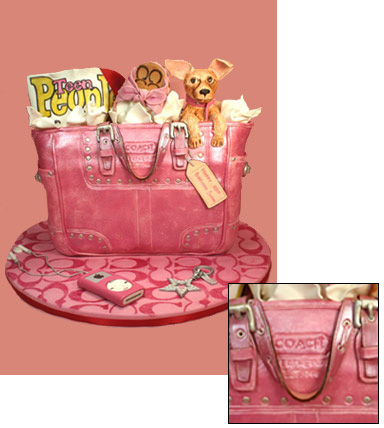
Counterfeit Chic has reported on plenty of baked fakes and DIY knockoffs, but this is the first recipe combining the two.  In theory, the two-minute CakesMadeEasy.com video will result in your own "Designer Knock Off" purse cake.  In practice, I'm imagining wall-to-wall crumbs and icing up to my elbows.  Still, it's the stuff of sweet dreams:

Legally speaking, yes, that quilting looks familiar -- but from the perspective of several different brands.  The style of the cake, moreover, is fairly generic.  So unless you add interlocking sugar C's or manage to spell out "Marc Jacobs" with your precision piping technique, you're free to rev up that oven.  (Note to SATC fans and denizens of small apartments:  Remove sweaters first.) 

May 15, 2008

Colonialism, Culture, and Copying

Cultural appropriation is a frequent theme in the world of fashion, from YSL's famous Ballets Russes collection to more or less any Dries Van Noten season.  In today's New York Times, Cintra Wilson casts a Critical Shopper's eye at the exuberant creations of Christian Lacroix -- and while she chastises the designer (and his clientele) for failing to age gracefully, the boutique's excesses inspired a series of creative mixed metaphors.  How often does slipping on a beaded bangle lead to colorful post-colonial political commentary?

While the rest of the developed world is circling Africa like a kettle of vultures, the French seem to be getting sentimental about the aesthetics of their old colonies.  It's a casual approach to the perpetual ransacking of pre-conquered cultures, old icons conveted into trendy adornments.  Old Gods are rendered symbolically meaningless at the moment that the dominant culture declares them adorable.  High fashion 1, Africa 0. 

For a lighter look at the connection between borrowed spirituality and material culture, enter the Blingdom of God.  Or pile on a few baubles of your own and enjoy my favorite work by Yeats.  Agree or disagree with his eloquent shrug at the end, there's no doubt that this coat's a  classic:

I made my song a coat 
Covered with embroideries 
Out of old mythologies 
From heel to throat; 
But the fools caught it,    
Wore it in the world’s eyes 
As though they’d wrought it. 
Song, let them take it 
For there’s more enterprise 
In walking naked.

Lacroix Spring 2008

April 27, 2008

Copying for Charity

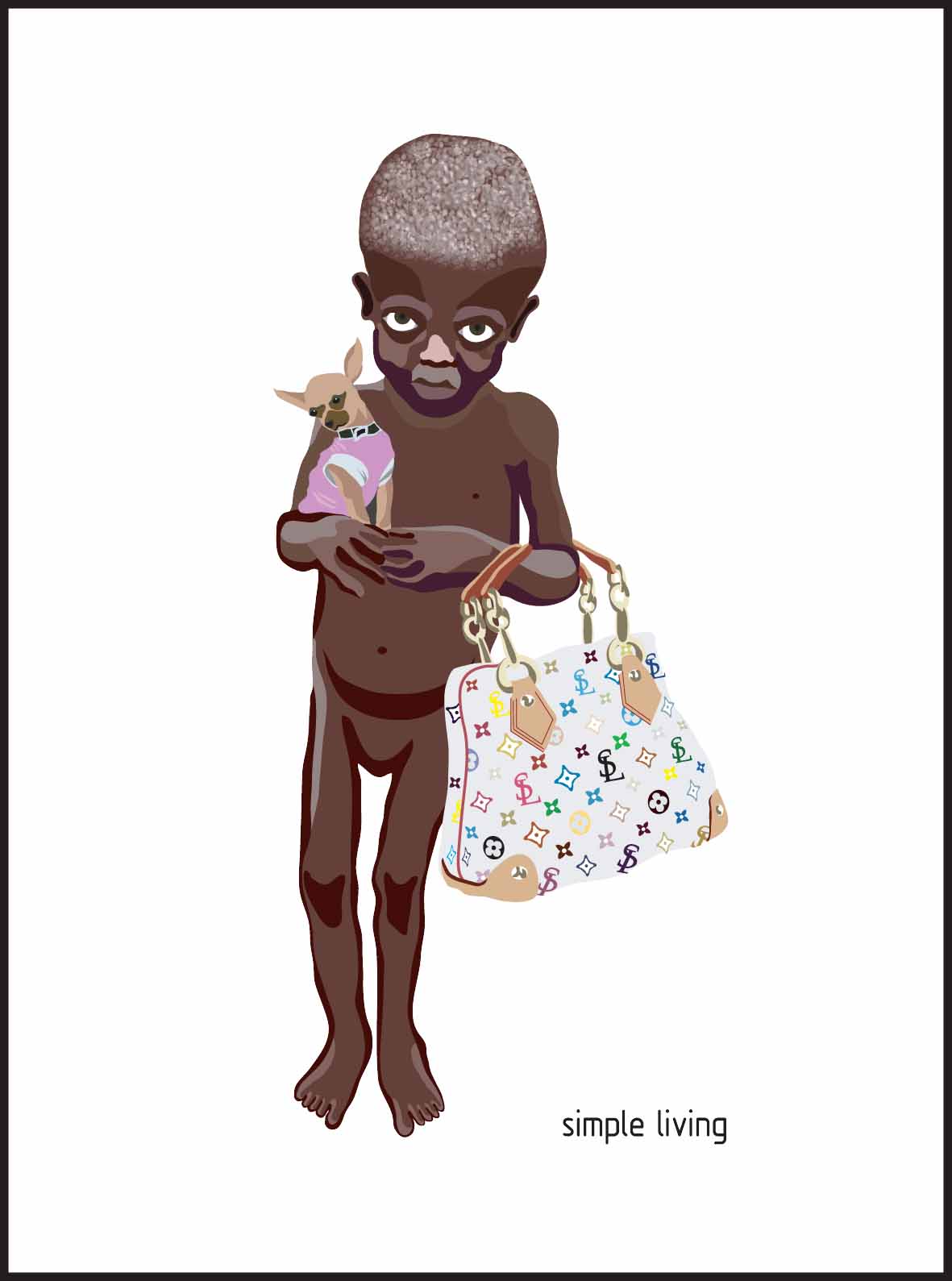
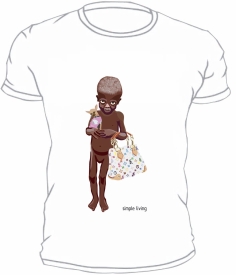
Click for larger imageJudging from my inbox, more than a few of you have heard that Louis Vuitton has sued Danish artist Nadia Plesner over the t-shirt design at left. 

The image casts a Sudanese child from the troubled Darfur region in the role of Paris Hilton, complete with small pink-clad dog and designer handbag, in order to criticize the media's excessive coverage of attention-seeking celebutantes rather than genocidal conflict.  In Nadia's words, "Since doing nothing but wearing designerbags and small ugly dogs appearantly is enough to get you on a magasine cover, maybe it is worth a try for people who actually deserves and needs attention."  (The lack of undergarments may also evoke Ms. Hilton, but the artist doesn't mention her model's unmentionables.) 

The issue for Louis Vuitton, however, is that Nadia didn't just depict any designer bag, but a version of the iconic Multicolore toile pattern, complete with the LV initials morphed into dollar and pound signs.  The company objected to this use as trademark infringement and asked Ms. Plesner to stop selling the t-shirts.  The letter is interesting in itself, since the tone is fairly unusual for a C&D -- "Hey, we're all artists here, and Takashi Murakami and Marc Jacobs collaborated on that bag," rather than the typical demands for an accounting of all units sold, disgorgement of funds, destruction of all remaining merchandise, and the head of the offending party on a platter.  It even offers a nod to Nadia's "Save Darfur" mission.  Still, LV very clearly wanted the shirts depicting its trademarks off the market -- and Nadia responded with a defense of her freedom of expression.  (She also somewhat surprisingly started out by arguing that her drawing refers to designer bags in general and not LV in particular, but more on that in a moment.) 

After Nadia and Louis Vuitton failed to reach an agreement, the company filed the lawsuit that has drawn far more attention than Nadia's initial project.  Without deciding the case, let's take a look at why there's an impasse. 

Q.  Why do Louis Vuitton's lawyers object to the t-shirt?

A.  The simplest answer is that their job is to protect LV's trademarks.  And, legally speaking, they're supposed to object to unauthorized commercial distribution of those marks.  A trademark holder that doesn't enforce its rights can ultimately lose them, as the marks may be considered abandoned or even generic.  Every time you ask for a Kleenex instead of a tissue or make a Xerox instead of a photocopy, a trademark lawyer somewhere gets another grey hair. 

The same is true for the extremely recognizable Multicolore pattern, which has been copied over and over again and is the subject of ongoing litigation between LV and other manufacturers.  It is the responsibility of LV's lawyers to make sure that the public's association between the Multicolore design and the company is not weakened in any way.  Thus Nadia's claim that her design "is inspired by - and refers to - designers bags in general - not a Louis Vuitton bag" is the last statement that would be reassuring or persuasive to a trademark lawyer. 

Q.  But Nadia created the t-shirts for charity -- doesn't that matter?

A.  Yes and no.  We all love a good cause, and we admire people who actually take action when confronted with evil. 

From a trademark lawyer's perspective, however, unauthorized commercial distribution is a threat, whether or not the profits go to a good cause.  Even charities that hold trademarks have problems protecting their marks from other philanthropic parties with similar purposes.  A representative of a prominent health-related nonprofit organization once told my class that she spends much of her time admonishing other groups that have put her organization's logo on their educational literature or their healthy products.  As she put it, "We're a charity, but we're not in the business of giving away our trademark."  Similar issues arise when trademarks are "borrowed" for religious purposes.  Trademark owners who object aren't necessarily grumpy atheists, just concerned about their marks. 

LV's initial letter to Nadia reflects this tension between sympathizing with social concerns and protecting intellectual property -- hence the unusually moderate request and tone for a C&D. 

Q.  So why didn't Louis Vuitton just give Nadia permission to use its trademark?

A.  One strategic option for any company whose trademarks have been used without authorization is to give permission, and also exercise some control, via a licensing agreement. 

Of course, Nadia didn't ask for permission.  And Louis Vuitton may or may not have been willing to grant it if she had, since its marks are constantly copied and copied again.  Also, while Nadia's stated intent was to criticize media attention to celebrities instead of tragedies, her profits from the t-shirts go to Divest for Darfur, an organization that opposes financial investment that ultimately funds genocide.  The presence of LV trademarks on the t-shirt could mistakenly be read to imply that Louis Vuitton had made investments that were helping to fund genocide -- not a message that the company would want broadcast, even in error.  In U.S. legal terms, LV could argue that Nadia was not only engaged in dilution of its well-known marks by blurring (basically overuse by non-owners) but also by tarnishment (negative association).

Q.  What about freedom of expression?

A.  Free speech is an important right, and one that every democratic society protects in different ways.  Intellectual property law establishes exclusive rights in specific expressions, but also attempts to maintain a balance between freedom of expression and creators' rights. 

In other words, at the same time that the law protects trademarks, it creates defenses for those who wish to use them in discussion (like the use of the name "Louis Vuitton" thoughout this post).  Different countries have different trademark laws and thus different defenses to unauthorized use.  In the U.S., the general standard is "fair use," including parody, while other jurisdictions have specific rules about what is or is not allowed in terms of expression.  To complicate matters even further, fair use of a trademark and fair use of copyrighted material are subject to different standards. 

In general, under U.S. law a visual artist is safer using a trademark to comment on or make fun of the trademark owner itself (parody) than to make other social statements (satire).  After all, it may be necessary to make limited use of a trademark to make a statement about its owner, but statements about other things can be made using other vocabulary.  Of course, whether or not something qualifies as parody or other protected speech may require a judicial decision.  Nadia writes that her goal was to make a statement about media coverage, not about Louis Vuitton. 

In her response to Louis Vuitton, Nadia also mentions Zbigniew Libera, a Polish artist who created LEGO concentration camp sets with blocks donated by the Danish company.  In the finished versions of the controversial work, Libera included a statement that his work was sponsored by LEGO.  The company vehemently denied knowlege of exactly what the artist had intended and filed a lawsuit that was later withdrawn.  The story is a cautionary tale for companies who choose to support artists -- whether by donating plastic blocks or the use of their designs -- but is ultimately quite different from Nadia's choice to act unbeknownst to Louis Vuitton. 

Q.  Do you think Paris Hilton will sue Nadia?

A.  Actually, I try not to think about Paris Hilton. 

But if I did, I might wonder whether she would assert a state law right of publicity claim against Nadia, much as she did against Hallmark.  If Vanna White can win her case against Samsung for posing a robot in a blonde wig on a game show set, then Paris could consider suing an artist for selling images of an African child with Hilton-style accessories.  Paris' case would be weaker here, however, since Nadia is criticizing the media for its coverage of Hilton's attention-seeking behavior and perhaps impliedly criticizing Hilton herself, rather than simply selling greeting cards or electronics. 

Q.  How can artists like Nadia avoid lawsuits by trademark holders?

A.  There's a lot of confusion out there as to what artists can and cannot do legally with corporate logos. Unfortunately, the law in this area is not entirely clear, and greater specificity would benefit both trademark holders and artists.  There are, however, some general principles.

For an independent artist, the safest option of all is not to use others' trademarks.  Any such use is a risk, and defending a lawsuit is time-consuming and expensive, even for an artist who ultimately wins.  (Now you know why so few lawyers have become great artists -- we're trained to think about worst-case scenarios.)

That being said, corporations are significant players in modern life, and as a society we need to be able to engage in commentary and criticism, whether that takes the form of op-eds or visual art.  A trademark is shorthand for a corporate entity itself.  The law thus recognizes and protects some critical or discursive use of trademarks. 

Before an artist uses a corporate trademark, she should think about whether or not her intention is to comment on the trademark holder -- and assess the risk according to the relevant national law.  If the use of someone else's trademark is just to make a visual joke or to sell the artist's own products, then that use is lawsuit bait, and the artist may very well be liable for damages.  And by the way, some companies are more determined than others when it comes to enforcing their rights. 

Of course, an artist's intent may be to transgress boudaries and challenge the law, but she should at least figure out where the line is before crossing it. 

Q.  And how should companies respond to unauthorized use of their trademarks by artists?

A.  As we've discussed, trademark holders are required to attempt to assert control over unauthorized uses, lest they lose their trademark rights entirely.  But for most holders of frequently copied trademarks, enforcement is a matter of allocating limited resources -- and managing public relations.  It's impossible to stop every counterfeit handbag seller on every street corner in the world, or to review every art school sketch to determine whether it's fair use.  Commercial sales in large multiples tend to make trademark lawyers see red; a one-off, transformative use may be worth only a shrug and a sigh. 

Q.  Who's going to win this case?

A.  That's a question for a Danish court -- although a settlement is still possible.  In the meantime, don't try this at home. 

Many thanks to Jenny Leugemors and Jayshree Mahtani, the first two to alert Counterfeit Chic to the story!

Via TorrentFreak.

April 21, 2008

Frenemies

Are you a Betty or a Veronica? 

Betty & Veronica Digest #183

In the opening story of the June 2008 Betty & Veronica Digest Magazine, the longtime rivals for Archie's affections become mutually unwilling mirror images.  Betty's defense?  "Don't look at me like that!  I just bought it, I didn't manufacture it!"  Even the end of the school day fails to bring relief, as the girls stomp off to a pep rally -- in identical cheerleader uniforms. 

It may look like a children's comic book, but for my USD $2.49, it's a pretty sophisticated commentary on originality and social conformity.  After all, true wisdom comes from recognizing that all of life is just a reiteration of high school

April 09, 2008

With Friends Like These...

When it comes to gift-giving, it's the thought that counts -- or at least a few recent Facebook apps seem to think so. 

Instead of buying an online friend a real-world gift, you can now send a virtual version guaranteed to fit perfectly, leave plenty of space in the closet, and never wear out.  My Dream Bags offers Prada, Vuitton, Jimmy Choo, and more, while Send Louis Vuitton (tagline:  You know your friends want it....) caters to the consumer whose brand loyalty is absolute. 

No, contrary to recent rumor, this is not a viral marketing campaign from Louis Vuitton.  And yes, it looks an awful lot like trademark dilution, with a bit of copyright infringement thrown in for good measure. 

Many thanks to Suni Sreepada for catching this one.  Facebook users, she's definitely an online friend worth having!

April 03, 2008

Louis Vuitton's Fake-Fighting Parody

"Life imitates art far more than art imitates life."

Oscar Wilde would've been ecstatic at the juxtaposition of life and art at the Brooklyn Museum earlier this evening -- and not just because it involved an abundance of luxury goods.  As guests arrived for the opening of an exhibit celebrating the art of Takashi Murakami and his collaboration with Marc Jacobs for Louis Vuitton, they were greeted by an outdoor scene more common on Canal Street:  logoed merchandise piled on tables or hung on metal pegs, graffiti-covered walls, stalls closed "by court order," and persistent vendors promising "best quality" and "best price."  The difference?  Those piles of LV Multicolore bags were real. 

Brooklyn gentrification gone Wilde!

Over the past 5 years, the Murakami/Vuitton partnership has produced some of the world's most copied handbags.  LV has responded with perhaps the world's most elaborate private anticounterfeiting operation, dedicating a team of 40 lawyers around the globe to pursuing its "zero tolerance policy" against copying.  Nowhere have LV's efforts been more extensive than in New York, where actions against landlords have established a beachhead against the counterfeiters who can seem more numerous than grains of sand. 

Of course, most of the 30,000+ raids that LV has conducted since 2003 have occured in relative silence.  Like other luxury companies, Louis Vuitton would rather draw attention to its products than to its issues with counterfeiting.  (Hence one of the most common questions directed to Counterfeit Chic:  If copying is illegal, why doesn't anyone do anything about it?  Answer:  They're trying.  Really!) 

New York's reputation as a counterfeit capital is hard to ignore, however.  Thus when Brooklyn Museum Director Arnold Lehman and LV Chairman and CEO Yves Carcelle discussed how to put a local spin on the © MURAKAMI exhibition, which had previously opened in L.A., their images of the city's vibrant street life inevitably turned to the dark side of our fabulous sidewalk agora:  fakes.  A popup installation and a bit of performance art turned out to be the perfect way to draw attention to the issue of what Lehman called "intellectual theft, Carcelle termed an "illness of the world," and Deputy Mayor Ed Skyler described as "a serious crime backed up by serious criminal enterprises."  Creative art used to express a commitment to legal protection of creative art -- now that's a New York moment.

While visitors to © MURAKAMI won't have the opportunity to buy a real LV handbag from a fake street vendor, there's nevertheless a seamless blend of art, commerce, and fashion inside the museum as well.  At the very heart of the exhibition, nestled between rooms of larger-than-life sculptures and giant painted canvases, is a tiny gem of a Louis Vuitton boutique.  Not only are all the newest versions of the Multicolore bag available here, but Murakami has also created a signed series of small art canvases in new "Monogramouflage" patterns.  At $6,000 each -- rising to $10,000 after the first batch sells out -- they're an artist's version of a diffusion line.  Or you can wait for the pattern to appear on LV handbags and other products, available at the museum as of June 1.  Another meeting of luxury and the street, a political reference, or a sly wink at the idea of overtly displayed "stealth wealth"?  Whatever the interpretation, the patterns are bound to be popular.

Takashi Murakami

Perhaps my favorite bit of the exhibit, though, wasn't the sculptures or even the guilt-free shopping, with a portion of the evening's proceeds earmarked for Homeland Security.  Instead, it was a moment of surprise as I stood in front of a glass case with an LV Murakami Cherry Blossom Retro handbag over my arm -- and realized that the flowers on my bag were smiling back at an exact duplicate.  OK, mine usually lives in a metal filing cabinet rather than a pristine display case, and its usual outings are to class to illustrate the idea of conceptual separability in copyright (the surface print is protected, the underlying design of the bag is not) rather than to elegant parties, but in that moment, it was wearable art.  And yes, it's real.

March 18, 2008

Obama Fan Strikes Out

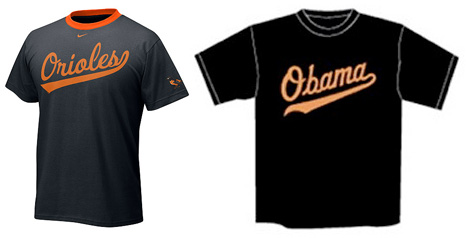
He built it, and they came.  Now the Obama supporter who developed a line of t-shirts based on baseball team logos has been forced to dismantle his website, ObamaofDreams.com, at the objection of Major League Baseball

While typefaces themselves are not protected by copyright, their use is frequently an essential trademark element.  MLB apparently claimed that Morris Levin's deliberate invocation of the nation's pastime, combined with his use of copycat lettering and color combinations, constituted trademark infringement.  And, as the Smoking Gun noted, even Hillary's official favorite teams -- the Yankees and the Cubs -- were Obamized. 

A word of advice to Levin:  Consider combining a JD with that Wharton MBA you're pursuing.  And don't mess with major league lawyers, unless you're looking for a bench-clearing brawl.   

March 07, 2008

Welcome Village Voice readers!

Lynn YaegerIt's not in Counterfeit Chic's nature to agree to disagree.  Being punished for "talking back" was a characteristic feature of my otherwise bookish and unrebellious childhood -- and perhaps the germ of my parents' impression that I'd be a good candidate for the lawyer in the family. 

When it comes to someone as intelligent, personable, and dedicated to fashion as Village Voice columnist Lynn Yaeger, however, I may have to make a rare exception.  And I certainly have to send you over to Lynn's most recent piece, for which she and I had a conversation about Oscar knockoffs. 

I still find it a bit odd that someone who's cultivated such an iconic personal image as Lynn -- love, love the Goyard tote customized with her portrait  -- wouldn't oppose fakes.  I'm also surprised that, as the fashion oracle of such  a celebrated alternative, downtown media outlet, she'd endorse derivative mass production.  I'd rather she inspired her readers to develop their own creativity, whatever the mainstream commercial trends might be. 

With so many aspiring young designers watching Project Runway and taking fashion seriously as a creative medium, why settle for looking like a bad copy of an overstyled celebrity on prom night?  Get creative, ladies!  (As I may have mentioned to Lynn, John Hughes' tooth-achingly sweet 1986 movie, Pretty in Pink, in which the impecunious Molly Ringwald character is forced to make her own prom dress but gets the guy anyway, should be required watching for the teen fashionista.) 

Lynn and I do agree on one thing, though:  She'd look amazing in Tilda Swinton's flowing Lanvin on the way to the podium to accept a Pulitzer. 

Thanks, Lynn!

February 28, 2008

Walk of Shame: Oscar Knockoffs by Faviana

Sunday's Oscar parties are over and the Monday hangovers have faded, but knockoff artists are still hanging around and sniffing at the leftover crumbs from the fashion banquet.  A Cachet copyist immediately revealed his top targets to WWD, and now the notorious Faviana label has named its own fashion victims, including two of the same dresses as Cachet.  

In addition to seeking secondhand publicity via Access Hollywood, Faviana has gone to great lengths to make sure that the models for its copied samples resemble the actresses who wore the original gowns to the Academy Awards -- or at least their morning-after incarnations.  Imagine Katherine Heigl with her curls gone flat and her roots showing, Jessica Alba with her bodice feathers bedraggled, Miley Cyrus haphazardly smearing lipstick around her mouth after partying with the grownups, or Amy Adams with shiny skin and an extra dessert under her belt, and you'll get the picture.  Or if your mind's eye refuses to conjure such wreckage, just scroll down: 

Katherine Heigl in Escada and Faviana knockoff

Jessica Alba in Marchesa and Faviana knockoff

Miley Cyrus in Valentino and Faviana knockoff

Amy Adams in Proenza Schouler and Faviana Knockoff

Girls, don't let these be your post-prom pictures -- just say no! 

And while the fashion police ponder these aesthetic offenses, does the legal system have anything to say for itself?  The gowns, of course, are unprotected by U.S. law -- but the photos may be subject to copyright.  Since Faviana is clearly using them for a commercial purpose, the company had better have sent its own photographer to snap these red carpet shots -- or at least licensed their use.  Even that wouldn't leave Faviana home free, however, if the actresses in question object to their images being used to hock fashion schlock.  Some of these leading ladies are reportedly paid a pretty penny to appear in the real thing, and it's unlikely that any one of them would agree to pose for a Faviana ad or to deputize a double to do so.  Perhaps the fashion houses can't take direct action against blatant copyists -- but there's nothing to say that they can't persuade their lovely mannequins to do so. 

For the moment, however, sweatshop season is in full swing -- and Counterfeit Chic has another pressing question to ponder.  Have I spent too much time staring at various trademarks, or (no offense to the charming and talented Proenza Schouler boys here) does the bodice of Amy Adams' gown recall the silhouette of Mickey Mouse? 

Many thanks to Steven Kolb for the links!

UPDATE:  Some wise words from Professor Rebecca Tushnet:

You know I respect your work, even if we may disagree on some things.  So I hope you'll take this as a friendly question:  did you really have to suggest that the decidedly skinny model in the last Faviana picture was fat?  Aside from accuracy -- and I admit, I don't follow fashion and I don't see such huge differences between the glowing stars and the nameless models -- I wish you wouldn't suggest that having an extra dessert is a problem.  When I see something like that, I have to wonder how fat you think I am and what you think that means about my moral standing.  Criticize the copyists all you want.  But it's hard for me to read attacks on the models for being, in my eyes, a perfectly reasonable -- skinny actually -- shape. 

And a response:

Point taken, Rebecca -- you're quite right, esp. with the skinny model debate and issues involving eating disorders in the industry and among the young women it influences still unresolved.  The model certainly isn't fat or even particularly curvy, though as I looked at the picture, I didn't like the shape created by the belt on the copy -- a straight belt or waistband in general is apt to create a strange tummy bulge even on a thin person where a curved belt or waistband won't (but requires more fabric and care in construction).
There's no moral implication about extra dessert, though -- just make mine chocolate.  I was  thinking of the various ways in which one's carefully constructed look can degrade over the course of an evening out -- mussed hair, lipstick re-applied after a few drinks, the need to loosen the belt after a gourmet dinner, etc. -- and I still find it amusing that the knockoff company tried to find doubles for the actresses but did such a sloppy job of styling them. 
Still, there are too many attacks on women based on unrealistic standards of body shape and size, and I don't mean for this post to be taken as one of them.  For the record, womanly curves and angles are both fine, and healthy is the ultimate ideal.  Thanks for the reminder that we're not yet living in a world where we can take that for granted.

February 26, 2008

Loss of Cachet

With so many actresses playing it safe at the Oscars, it was a lean year for the red carpet scavengers seeking knockoff fodder. 

Michael Ruff of Cachet, however, has gone on record with WWD about his top targets.  Naturally, there will be long red dresses -- a trend that will be noted by real designers seeking inspiration and design pirates alike.  The soon-to-be Cachet copies include Heidi Klum's John Galliano, Anne Hathaway's Marchesa (red carpet bait as soon as it came down the runway; it was just a matter of which actress), and Katherine Heigl's Escada:

The company also announced plans to replicate Jessica Alba's aubergine Marchesa (though presumably not in pregnant proportions), as well as Jennifer Garner's Oscar de la Renta and Penelope Cruz's Chanel:

Ruff may be barking up another tree, though, if Harvey Weinstein, the movie mogul and now spouse of Marchesa co-designer Georgina Chapman, hears about his plans.  Last year, when another manufacturer boasted of his intent to copy a Marchesa straight off the red carpet (this one, perhaps?), Weinstein played the good boyfriend and beat up the guy called his extremely famous trial lawyer.  Somehow, the would-be copyist changed his mind.  Now Cachet claims it's going to copy two Marchesas...

The copying is, of course, legal in the U.S. -- at the moment.  Perhaps Harvey's bulldog invoked trade dress protection, since the dress was immediately famous; perhaps he considered the probability of distribution to a foreign jurisdiction where the copying might be actionable; perhaps he simply threatened to dog the copyist's footsteps with various legal challenges for the rest of his natural life.  Whatever the tactics, they're unlikely to be successful -- or even available -- in most cases.

For the moment, then, Cachet is simply cackling over its Academy Awards loot and calculating its prom-season profits.  The beading and other details on some of the gowns are too expensive to copy, Ruff notes, "But with the others, especially the one-shoulder dresses, we will be able to do something more exact."

January 03, 2008

Parody Panties

BoingBoing's Cory Doctorow certainly found an interesting souvenir on his trip to Shanghai: 

But does calling the panties a parody make it so? 

Not necessarily.  Painting the word "fake" on a counterfeit handbag -- or a real one, for that matter -- can be construed as cultural commentary, given the prominence of the great fake debate.  Printing the word "parody" on Mickey Mouse panties doesn't seem to be commenting on much of anything, since discussion surrounding trademark infringement rarely involves cartoon undergarments.  Moreover, the target customer for girls' briefs in China (presumably not Mr. Doctorow, but one never knows) may not read much English or understand the word "parody" -- but Mickey himself needs no translation.

Perhaps in another context the panties could be considered a commentary on the famous mouse's squeaky-clean image.  Then again, Disney seems to have no objection to slapping authorized versions of its characters' smiling visages on fans' bottoms.

At the end of the day, the Mickey knickers are just another twist on the disclaimer myth:  Hmmm, copying is illegal, but parodies that involve some copying are legal, so maybe if I label my copy a parody, I'll get away with it....at least until Disney launches a retaliatory panty raid. 

Nice try.

Many thanks to Counterfeit Chic reader Rory Solomon for the tip!

December 17, 2007

What Not to Wear, Canine Edition

Fans of the U.S. television show What Not to Wear (yes, a knockoff of the British original) will recognize host Stacy London in her spinoff show, Fashionably Late.  Some of the red carpet gowns that Stacy recently featured may also look suspiciously familiar -- though the long-limbed models are of the four-legged rather than the two-legged kind. 


This isn't the first time that Counterfeit Chic has covered the Little Lilly canine couture copies -- or noted that while Lara Alameddine's doggie dresses themselves do not violate intellectual property laws, use of celebrity photos or an image of a trademarked award might.   

America Ferrer's Monique Lhullier gown and copy

Interestingly, despite the outcome of the widely publicized "Chewy Vuiton" case, American designers have thus far shown little interest in limiting knockoffs intended for pets.  The proposed Design Piracy Prohibition Act makes no mention of animal clothing in its definition of fashion designs, so presumably even an exact copy of a Shih Tzu's sweater or a poodle's poncho would be fair game after passage of the bill (apart from any logos or labels).  A canine version of a couture gown might might meet the test for determining infringement of the original, but it is by no means certain that the adapted version would be sufficiently similar to the original to trigger protection -- even if marketed as a copy. 

Perhaps the canine couture market is too small to attract attention, or perhaps our biological predisposition to favor neotenous creatures makes us unwilling to censure anything that makes adorable little dogs even more so -- at least the eyes of those who regularly match their pets to their handbags. 

But with all due respect to Ms. London's guest, Counterfeit Chic's four-legged friends appear to prefer wearing only their own original -- and fabulous -- furs.   

November 27, 2007

Black Friday Fakes and Cyber Monday Scams

Amid nervous projections of retail malaise this holiday season, counterfeit goods are bound to prosper, right?  After all, consumers dismayed by high gas prices, a soft housing market, and other inhospitable indicators may well turn to fakes for their style fix.

Think again.

According to the New York Post, Manhattan street peddlers are feeling pinched by lack of interest from potential buyers and increased attention from the police.  One watch dealer complained that his folding-table display generated $800 in sales on the day after Thanksgiving last year -- but only $200 this Black Friday.

And what of Cyber Monday, the day when we return to the office and begin our online holiday shopping, sometime between interminable meetings and emails from the boss?  Judging from the amount of Monday morning spam offering genuine replica goods, counterfeiters are out looking for a holiday score -- but, according to MarkMonitor's information-packed Brandjacking Index, so are phishers and gift card scammers.  It remains to be seen whether the heightened perils of typing in a credit card number on a shady site and pressing "enter" will affect internet shopping patterns.

In the meantime, enjoy the office parties and eggnog excesses.  Oh, and watch out for this guy...

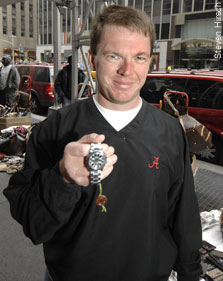
Steven Hirsh photo of Alabama tourist Mike Dunn

...whom the Post snapped showing off his new $20 "Rolex."  If he's your Secret Santa, you're better off with a lump of (candy) coal.

November 26, 2007

Counterfeit Coffee Break 6

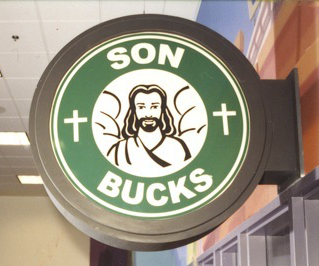
Today's counterfeit coffee break poses a corporate conundrum:  What if you've been knocked off by God?  (Or at least someone who speaks to -- and about, and perhaps for -- Him regularly?)

A New Yorker article on the spread of megachurches to the once staunchly Protestant and now culturally Catholic New England area features Pastor Frank Santora, his Faith Church, and its invitation to spend your day of rest with an infusion of caffeine.  It's not clear from the article whether SonBucks actually sells coffee -- unlike at StarBucks, the baristi are reportedly volunteers -- but the reporter observed members of the congregation as they "drifted into the sanctuary, some carrying their Styrofoam cups with them."  Why settle for communion wafers and wine when you could be giving thanks for a cappuccino?

Of course, SonBucks coffee raises ethical and doctrinal questions as well.  "Thou shalt not steal" others' trademarks to sell coffee (Exodus 20:15), but then again, "What has been will be again, what has been done will be done again; there is nothing new under the sun" (Ecclesiastes 1:9).  And if God created everything in the first place, what's a little trademark infringment and/or dilution among the faithful? 

Still, I wouldn't necessarily stand under the SonBucks sign in a thunderstorm....

P.S.  For more examples of logo-based evangelism, check out this post from Copywrite (via Likelihood of Confusion).

November 20, 2007

Gourmet Spam

Every bright new technology casts a shadow -- and for email, that dark side is spam.  You can fight it with filters, you can unsubscribe from as many lists as possible, you can delete it...or, like artist and illustrator Linzie Hunter, you can embrace it.

Linzie was inspired by the spam one-liners in her inbox to create a series of "experiments with hand lettering" -- a nice complement to her digitally created work.  Think there's nothing in particular to be gleaned from junk email?  Behold the soul of a spam:

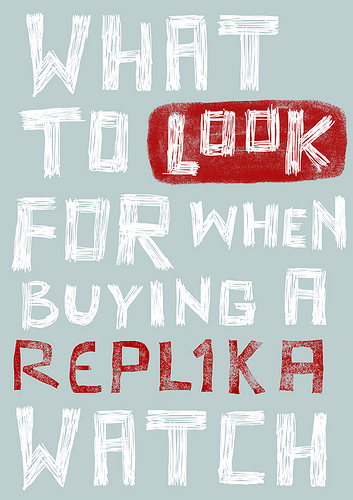
Repl1ka Watches from Linzie Hunter's Spam One-liners

"Repl1ka watches," with its clever emphasis on the "look," is Counterfeit Chic's favorite, naturally -- but don't miss the rest of Linzie's incredibly creative cultural commentary!

UPDATE:  Select prints available at Thumbtack Press -- for less than the cost of many "repl1ka" watches!

November 07, 2007

Funny Girls

Think the idea of dressing your wee bairns in genuine designer labels is a bit premature?  So does Deadly Girl Couture -- but the label isn't above poking a bit of gentle fun at the idea. 

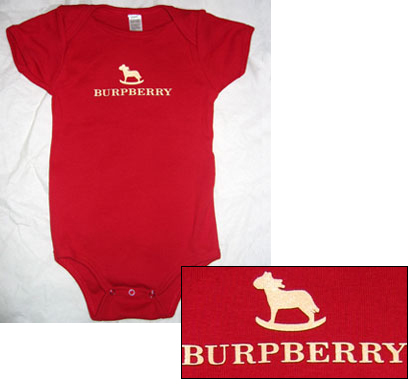
Check out Gucci Coo, Louis Spitton, Pradada, Dolce & Grandpa (and Dolce & Grandma, naturally), and finally Burpberry -- complete with the Burberry knight transformed into a rocking horse.   

Deadly Girl Couture Burberry parody

Best of all -- and perhaps helpful should the need of a parody defense arise -- there's not a bit of plaid in sight. 

Of course, the Deadly Girls will no doubt want to keep close watch on a case involving the similarly brand-conscious comediennes over at Haute Diggity Dog (appellate decision pending after oral argument before the U.S. Court of Appeals for the Fourth Circuit on September 26 -- stay tuned). 

Many thanks to brilliant and distinguished Fordham law grad Brit Payne for the tip. 

October 22, 2007

Watch Out!

Pssst!  Want to buy a watch?

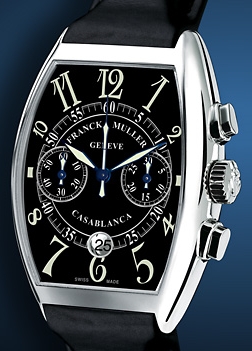
According to an article by Liza Casabona in this month's WWD Accessories supplement (not available online), seizures of counterfeit watches are on the rise.  So far this year, watches and watch parts account for 10 percent of the goods seized by U.S. customs, following only apparel and footwear, and up from 2 percent for fiscal 2006.  And that's not including online sales of "replica watches," or the legally more complex issue of jewelers altering less expensive versions of genuine watches to look like their pricier counterparts by, for example, adding diamonds.  (Thus far, the brands are winning their trademark infringement cases, based on the argument that the modified watches are misrepresented as original workmanship and do not carry disclaimers.) 

Perhaps counterfeit retailers have finally decided to target all the guys hanging around on Canal Street while their female friends are buying fake handbags.

And yes, those quotes are from your favorite law prof -- thanks, Liza! 

P.S.  Doubt the trend?  There's even a website that reviews replica watches:

October 21, 2007

One, Two, Three, Many

When I was very little, my mother periodically drove by a McDonald's that, under its golden arches, proudly proclaimed, "Over X Million Served."  Every so often, the figure would rise.  I never actually saw anyone on a tall ladder changing the numbers, but the statistic was a source of fascination nonetheless.  How many zeros in a million?  Was that only hamburgers, or cheeseburgers too?  What would they look like piled up?  Did the number include that franchise only, or the whole chain?  If we went in and ordered a lot of hamburgers, could we get the numbers to change?  And how did McDonald's keep track? 

At some point, the millions became billions, and then the sign changed.  It read simply, "Billions and Billions Served."  I stopped paying attention.

Fabulous photo of a cultural phenomenon

Source:  Elena777 on Flickr

Industries fighting counterfeiting clearly understand the power of large numbers.  The problem is that illegal goods are somewhat harder to track than McDonald's hamburgers.  Do counterfeit sales add up to $600 billion per year, or is the number closer to $200 billion (exclusive of domestic manufactures and downloads)?  Last year Felix Salmon, who also writes for Conde Nast Portfolio, made an effort to track the source of the most widely quoted counterfeit figures.  His conclusion?  "All counterfeiting statistics are bullshit."  On Friday the Wall Street Journal's Numbers Guy, Carl Bialik, raised similar questions about piracy's "fuzzy figures" and the difficulties inherent in generating hard numbers. 

Nobody seems to deny that there is massive global trade in counterfeit goods.  Nor is there any question that back alley sales represent lost tax revenues, in addition to other complaints.  Quantifying the fake trade, however, is an elusive task. 

Why, then, the insistence upon numbers?  Perhaps it's just because journalists and lawmakers always ask for them.  Of course, from an efficiency standpoint, it make sense to understand the scope of the problem before committing resources to legal enforcement.  But more importantly, advertisers have known for year that numbers are both attractive and persuasive.  Just ask Mr. Heinz and his 57 Varieties

So, how big is the counterfeit trade?  Let's just say, billions and billions sold. 

September 12, 2007

Counterfeit Coffee Break 5

It's been a while since our last counterfeit coffee break, but if you -- or any of the under-12 set in your general vicinity -- need refreshment, this one's for you.

Advertising Age reports that Burger King, in a response to health concerns regarding fast food, has introduced apples cut to resemble french fries and served in a paper container.  So far, so good.  The catch?  Burger King has named its new apple offering the "Frypod."

Open your mouth and download soon, before one badly labeled apple spoils the whole barrel.  I'd guess that unless Burger King's use is authorized, Apple won't consider the name's resemblance to "iPod" particularly salutary. 

September 04, 2007

Power Dressing

Remember when Condoleezza Rice was the most powerful woman in the world -- and dressed the part?  In a memorable column, Washington Post fashion critic Robin Givhan described Condi in her stiletto-heeled boots and long, military-style coat as "draped in a banner of authority, power and toughness." 

Photo Michael Probst - AP

Alas, 2 1/2 years later it seems that Condi's strong, independent voice isn't what many had hoped -- and neither is her wardrobe.  Did Air Force One lose her luggage on the way to Iraq, forcing her to borrow one of her boss's suits, or has she become our fearless leader's mini-me

Photo Jason Reed - Reuters 

Copying Clothes Over a High-Speed Connection

What would life be like without the mixed blessings of the internet?

In today's New York Times, Eric Wilson goes behind the scenes at Simonia Fashions, one of many companies waiting for the first photos from New York Fashion Week to appear online.  Not because the proprietors are interested in fashion's new creative direction, mind you, but so that they can pick out the most popular designs and get cheap copies into stores -- often before the originals are available for sale. 

Naturally, the retailers selling the knockoffs disclaim any actual knowledge of copying, pointing back to their suppliers as the source of the controversial clothing. 

In the U.S. all of this occurs without interference from any of those inconvenient intellectual property laws that might actually protect creative fashion designers.  Interestingly, the company featured in the article outsources its manufacturing to India, where design protection does exist.

It's enough to make one long for the good old days days of rough pencil sketches and descriptions sent via telegraph.

Tory Burch (left) and Simonia Fashion's Blue Plate special (right)

Bonus point:  Who is the "expert working with the designers’ trade group" who in the article offered a rock-bottom, minimum estimate of the percentage of knockoffs in the apparel and accessories market?  You guessed it.  And just for the record, since some of you have asked, I do not now nor have I ever represented the CFDA; all of my opinions are my own and are the product of my academic research.  All of my work on this issue, moreover, has been pro bono -- both in the literal sense of "for the good" and in the more colloquial sense of "free of charge." 

August 30, 2007

A Shocking Reward

At the Judge Rotenberg Educational Center in Canton, Massachusetts, behaviorally challenged students are "treated" with powerful electric shocks for acting aggressively, rising from their seats without permission, swearing, nagging, and perhaps even "failing to maintain a neat appearance."

And when they do behave?  There's also a system of rewards, including points that can be spent on, among other things, "knockoff Prada purses." 

Only one of these practices is illegal.

Thanks to Professor Rebecca Tushnet for sending the truly disturbing story from Mother Jones

August 23, 2007

i believe...

...that Elizabeth Arden's PR department is working overtime to deal with this -- ahem! -- oversight in its ad campaign for the Britney Spears Believe fragrance.

True, nobody is likely to confuse Britney with a charity (of late a charity case, perhaps), and fragrance and socially conscious t-shirts hardly fall into the same category.  The use of a typeface and colors so extremely similar to Mondonation's just doesn't pass the smell test, however.  Stealing is bad; stealing from a social enterprise is worse. 

What does it say about the modern era when you wake up and put on a save-the-world-type t-shirt, only to find yourself a walking billboard for celebrity perfume? 

July 02, 2007

Creators v. Consumers

From Rob Walker, the gifted journalist and consumer guru who called attention to Prestigious' "Stop Rockin' Fake Shit" T-shirts, comes notice of a new blog, StartRockintheFakeSht.  As the name implies, the anonymous authors both support knockoffs and call into question the value of authentic merchandise -- and some seem angrier than others. 

But why such polarized views on rockin' fake shit?

It's all a matter of perspective.  First consider creation.  An aspiring creator who manages to sell a painting, a story, or a dress can't necessarily afford to be copied by a commercial venture that recognizes the value of the work and can engage in cheap mass production-- but doesn't want to pay the creator.  Even established creators may suffer from the presence of a large quantity of knockoffs in the market, since they dilute the value and perceived quality of originals.  "Fake shit" thus harms creators, especially if not enough consumers insist on having an original, authentic work. 

Now consider consumption.  An aspirational consumer who wants a design wants it NOW -- and doesn't necessarily want to pay the creator's price or accept the concept of limited production.  Such desire may be cast in anti-elitist or faux populist terms, but at base it is not about basic life needs (even, in most cases, information); it is about individual aesthetic gratification.  Such a consumer will envy wealthier or better connected consumers who do have access the item, especially if it is an obviously expensive "status good."  (It is, however, inaccurate to cast all targeted originals as extremely expensive; both creativity and copying occur at all price points.)  From the perspective of the covetous consumer, then, "fake shit" offers instant gratification and mocks both consumers and creators of genuine goods.

Intellectual property law intends to benefit both creators and consumers -- by focusing its protections on creators.  Ask any U.S. IP student about the purpose of the system, and you'll (hopefully!) be reminded of the Article 1, section 8, clause 8 of the Constitution, which empowers Congress:

To promote the Progress of Science and useful Arts, by securing for limited Times to Authors and Inventors the exclusive Right to their respective Writings and Discoveries....

The immediate benefit is to creators, to "Authors and Inventors."  The collective benefit is to society at large, which gains from "the Progress of Science and useful Arts" and from having creators with the opportunity develop their skills.  The eventual benefit is to individual consumers, not because they can immediately rock fake shit, but because more creativity means more choices overall in the long run. 

We are all consumers.  And virtually all of us (Mother Theresa or the Dalai Lama aside) have been covetous consumers at some point or other, whether or not our desires would have been satisfied by knockoffs.

In modern industrialized economies and in the internet era, more and more of us are also creators.  We are no longer dependent on agriculture or manufacturing to support the economy; we rely instead on industries that generate intellectual property.  Moreover, while a creative class still supplies us with music, movies, literature, and other artistic diversions, there's also YouTube, MySpace, and Second Life.  Both in our work lives and in our private lives, creative endeavor is not specialized but universal. 

And if we are all creators, then the debate over whether to stop or to start rockin' fake shit takes on a whole new dimension. 

June 19, 2007

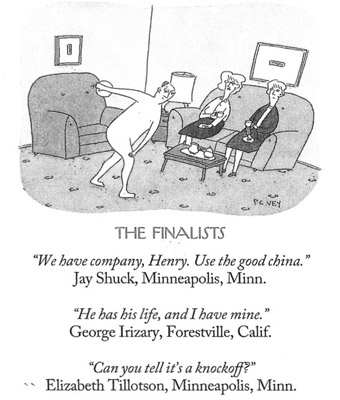
A Heideggerian Lament

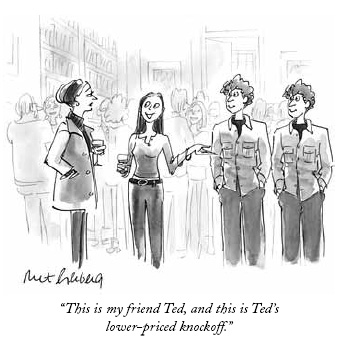
Or, if knockoffs could speak.

Source:  New Yorker, June 25, 2007.

June 18, 2007

Don't Cut that Cake!

Is there any part of a wedding that can't be faked?

Between amateur knockoff artists sneaking forbidden cameras into their appointments at bridal boutiques and deceived brides lamenting the gift of faux engagement rings or wedding bands posing as pure platinum, it's enough to turn the most starry-eyed romantic into a counterfeit-spotting cynic.

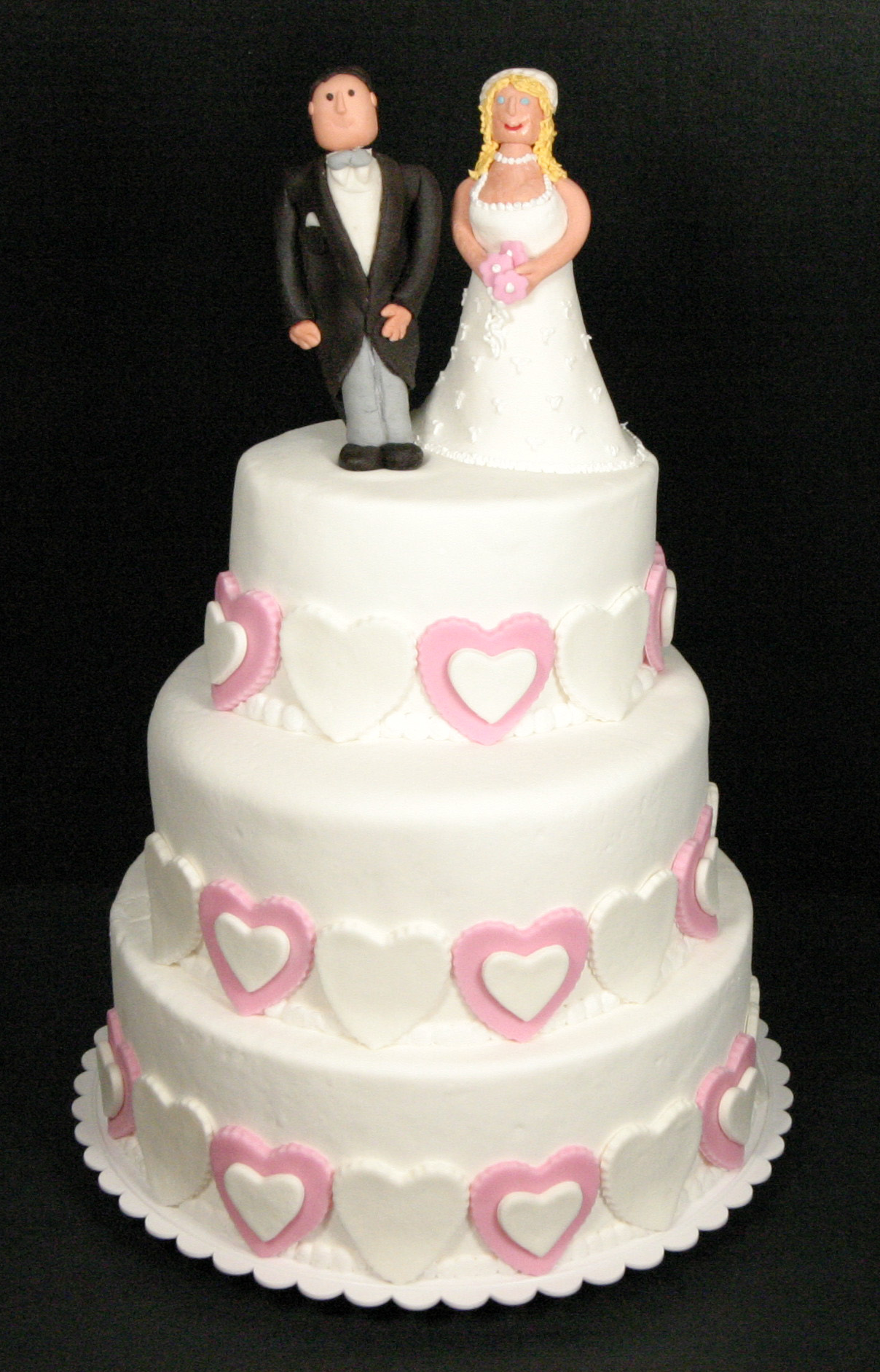
Still, there's something amusing about the latest entry in the imitation bridal market:  fake cakes.  Covered in icing and decorated to look like the real thing, these tiers of Styrofoam are intended for display at the reception.  After the happy couple cuts into a secret spot containing a slice of real cake, the fake is removed to the kitchen -- preferably with some dramatic staggering by the waitstaff -- and slices of an ordinary sheetcake are served to unsuspecting guests.  Then, in the case of CakeRental.com, the stand-in is returned to its specially designed shipping crate and sent back for the next time.  Sort of like your great-aunt's porcelain monstrosity of a wedding present, destined to be re-gifted over and over again. 

Tune in next time for the blow-up groom....

Many thanks to Karen Quartuccio for the tip!

P.S.  A public service announcement for budget-minded brides:  You may have missed last year's fast fashion feeding frenzy involving Victor & Rolf's wedding gowns for H&M, but other cheap chic chains are getting into the act.  This weekend's WSJ gave top marks to Isaac Mizrahi's "Trapunto Bell" design for Target, USD $159.99.  Why settle for a knockoff when the real designer will provide one for you?