Main

July 01, 2008

Pope Pirate I, Part II

It's official:  The devil wears Prada, but the Pope wears Prada knockoffs. 

It seems that His Holiness wishes to exorcise the persistent rumor that his red shoes are by Prada.  L'Osservatore Romano, the Vatican newspaper, last week categorically denied that Benedict XVI indulges in designer footwear, stating instead that the pontiff patronizes a cobbler from Novara, Italy.  Who may or may not be inspired by a light in the east -- about 50 km east, in Milan, to be exact.

But who designed the Easter bonnet?

Via His Superfabulousness, the Manolo.   

June 30, 2008

Strike 2: eBay loses to LVMH

The gavel has fallen -- and hit online auctioneer eBay pretty hard.

In a much anticipated decision, a French court today ordered eBay to pay LVMH 38.6 million euros for allowing the sale of counterfeits on its site.  The award is allocated among several divisions of the luxury conglomerate, primarily LVMH and Christian Dior Couture, with smaller amounts to perfume brands Christian Dior, Givenchy, Guerlain, and Kenzo. 

Following on the heels of Hermes' victory against eBay in another French court earlier this month, the decision essentially shifts more of the responsibility for policing offerings to the auction site, which profits from each sale -- counterfeit or not.  After learning of its loss in court, eBay immediately announced its intention to appeal and went on a rhetorical offensive, stating, "Today's decisions are not about fighting counterfeiting. It's about LVMH's desire to protect commercial practices that exclude all competition." 

Obviously the French judges haven't bought eBay's argument -- but will home court advantage help?  Or will the long awaited U.S. decision in Tiffany v. eBay be strike 3 for the auction site?  Stay tuned.

(For background on the case, click here.) 

June 04, 2008

Party Time

Summer's hottest trend is here!  No, it's not gladiator sandals or splashes of superhero-worthy primary color -- it's lawsuits claiming 3rd-party liability for copyright and trademark infringement. 

Today a French court ordered eBay to pay Hermes 20,000 euros after the internet auction site allowed a user to sell 3 Hermes handbags, 2 of which turned out to be counterfeit.  The court's decision is also supposed to appear on eBay's French homepage, but no sign of it yet.  The site does have an extensive anti-counterfeiting page, though.  (Thanks to Counterfeit Chic reader Deb Mason for the tip!)

The ruling in favor of Hermes could be just the tip of the iceberg for eBay's French operations.  20,000 euros may cover a couple of basic Birkins, but, in a separate pending case against eBay, luxury giant LVMH has demanded damages of €20 million.  According to Le Monde, a decision is due by the end of the month.

Meanwhile, on this side of the Atlantic, the U.S. Supreme Court has let stand a 9th Circuit decision in Perfect 10 v. Visa, absolving the credit card company of liability for facilitating sales of infringing goods.  As WWD's Liza Casabona notes, however, questions of contributory and vicarious liability will continue to occupy the legal landscape, with a decision in Tiffany v. eBay still undecided.  (Thanks for the quote, Liza!)

Seems that the lawyers pursuing 3rd-party liability claims on behalf of their fashion clients have come up with not only a legal strategy, but a lifestyle mantra:  After the law shows up at one party, move on to the next.  Not a bad way to spend a hot summer night.

Continue reading "Party Time" »

May 15, 2008

Colonialism, Culture, and Copying

Cultural appropriation is a frequent theme in the world of fashion, from YSL's famous Ballets Russes collection to more or less any Dries Van Noten season.  In today's New York Times, Cintra Wilson casts a Critical Shopper's eye at the exuberant creations of Christian Lacroix -- and while she chastises the designer (and his clientele) for failing to age gracefully, the boutique's excesses inspired a series of creative mixed metaphors.  How often does slipping on a beaded bangle lead to colorful post-colonial political commentary?

While the rest of the developed world is circling Africa like a kettle of vultures, the French seem to be getting sentimental about the aesthetics of their old colonies.  It's a casual approach to the perpetual ransacking of pre-conquered cultures, old icons conveted into trendy adornments.  Old Gods are rendered symbolically meaningless at the moment that the dominant culture declares them adorable.  High fashion 1, Africa 0. 

For a lighter look at the connection between borrowed spirituality and material culture, enter the Blingdom of God.  Or pile on a few baubles of your own and enjoy my favorite work by Yeats.  Agree or disagree with his eloquent shrug at the end, there's no doubt that this coat's a  classic:

I made my song a coat 
Covered with embroideries 
Out of old mythologies 
From heel to throat; 
But the fools caught it,    
Wore it in the world’s eyes 
As though they’d wrought it. 
Song, let them take it 
For there’s more enterprise 
In walking naked.

Lacroix Spring 2008

April 28, 2008

The Naughty List

Uncle Sam has released this year's naughty list, a.k.a. the 2008 "Special 301" Report, analyzing other nations' intellectual property enforcement efforts.  And sure enough, China is getting a lump of coal in its stocking this year, along with 8 other "priority watch list" countries and 38 on the lower-level "watch list."

Norman Rockwell 1939

In other bad news for China, Louis Vuitton has decided to pick up its toys and go home.  The boutiques will stay -- but amidst anti-French protests relating to Gallic support for the Dalai Lama, LV has postponed the "China Run" vintage car rally originally scheduled for late May

For smokin' analyis of China and intellectual property, remember to vist IP Dragon

April 27, 2008

Copying for Charity

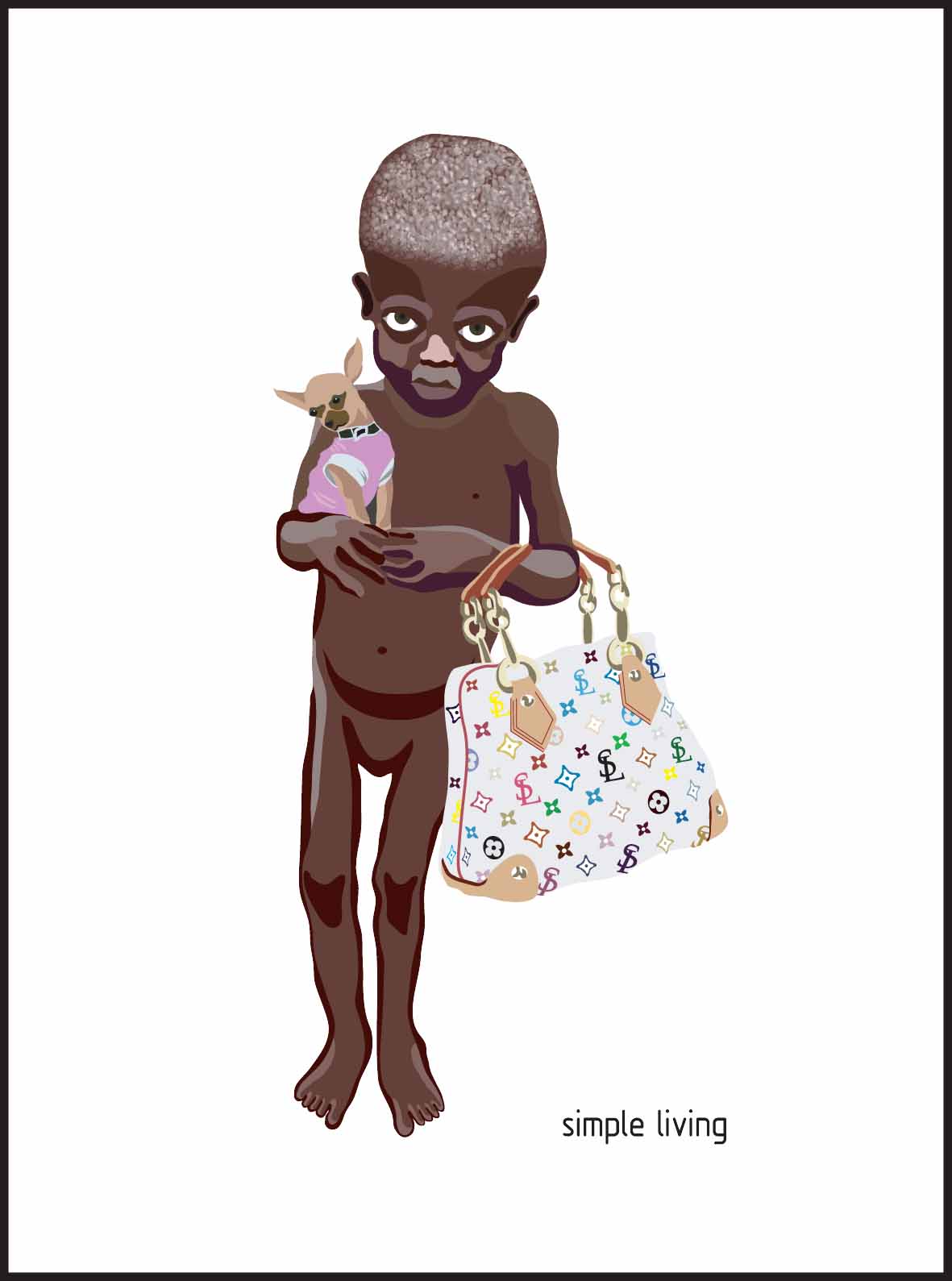
Click for larger imageJudging from my inbox, more than a few of you have heard that Louis Vuitton has sued Danish artist Nadia Plesner over the t-shirt design at left. 

The image casts a Sudanese child from the troubled Darfur region in the role of Paris Hilton, complete with small pink-clad dog and designer handbag, in order to criticize the media's excessive coverage of attention-seeking celebutantes rather than genocidal conflict.  In Nadia's words, "Since doing nothing but wearing designerbags and small ugly dogs appearantly is enough to get you on a magasine cover, maybe it is worth a try for people who actually deserves and needs attention."  (The lack of undergarments may also evoke Ms. Hilton, but the artist doesn't mention her model's unmentionables.) 

The issue for Louis Vuitton, however, is that Nadia didn't just depict any designer bag, but a version of the iconic Multicolore toile pattern, complete with the LV initials morphed into dollar and pound signs.  The company objected to this use as trademark infringement and asked Ms. Plesner to stop selling the t-shirts.  The letter is interesting in itself, since the tone is fairly unusual for a C&D -- "Hey, we're all artists here, and Takashi Murakami and Marc Jacobs collaborated on that bag," rather than the typical demands for an accounting of all units sold, disgorgement of funds, destruction of all remaining merchandise, and the head of the offending party on a platter.  It even offers a nod to Nadia's "Save Darfur" mission.  Still, LV very clearly wanted the shirts depicting its trademarks off the market -- and Nadia responded with a defense of her freedom of expression.  (She also somewhat surprisingly started out by arguing that her drawing refers to designer bags in general and not LV in particular, but more on that in a moment.) 

After Nadia and Louis Vuitton failed to reach an agreement, the company filed the lawsuit that has drawn far more attention than Nadia's initial project.  Without deciding the case, let's take a look at why there's an impasse. 

Q.  Why do Louis Vuitton's lawyers object to the t-shirt?

A.  The simplest answer is that their job is to protect LV's trademarks.  And, legally speaking, they're supposed to object to unauthorized commercial distribution of those marks.  A trademark holder that doesn't enforce its rights can ultimately lose them, as the marks may be considered abandoned or even generic.  Every time you ask for a Kleenex instead of a tissue or make a Xerox instead of a photocopy, a trademark lawyer somewhere gets another grey hair. 

The same is true for the extremely recognizable Multicolore pattern, which has been copied over and over again and is the subject of ongoing litigation between LV and other manufacturers.  It is the responsibility of LV's lawyers to make sure that the public's association between the Multicolore design and the company is not weakened in any way.  Thus Nadia's claim that her design "is inspired by - and refers to - designers bags in general - not a Louis Vuitton bag" is the last statement that would be reassuring or persuasive to a trademark lawyer. 

Q.  But Nadia created the t-shirts for charity -- doesn't that matter?

A.  Yes and no.  We all love a good cause, and we admire people who actually take action when confronted with evil. 

From a trademark lawyer's perspective, however, unauthorized commercial distribution is a threat, whether or not the profits go to a good cause.  Even charities that hold trademarks have problems protecting their marks from other philanthropic parties with similar purposes.  A representative of a prominent health-related nonprofit organization once told my class that she spends much of her time admonishing other groups that have put her organization's logo on their educational literature or their healthy products.  As she put it, "We're a charity, but we're not in the business of giving away our trademark."  Similar issues arise when trademarks are "borrowed" for religious purposes.  Trademark owners who object aren't necessarily grumpy atheists, just concerned about their marks. 

LV's initial letter to Nadia reflects this tension between sympathizing with social concerns and protecting intellectual property -- hence the unusually moderate request and tone for a C&D. 

Q.  So why didn't Louis Vuitton just give Nadia permission to use its trademark?

A.  One strategic option for any company whose trademarks have been used without authorization is to give permission, and also exercise some control, via a licensing agreement. 

Of course, Nadia didn't ask for permission.  And Louis Vuitton may or may not have been willing to grant it if she had, since its marks are constantly copied and copied again.  Also, while Nadia's stated intent was to criticize media attention to celebrities instead of tragedies, her profits from the t-shirts go to Divest for Darfur, an organization that opposes financial investment that ultimately funds genocide.  The presence of LV trademarks on the t-shirt could mistakenly be read to imply that Louis Vuitton had made investments that were helping to fund genocide -- not a message that the company would want broadcast, even in error.  In U.S. legal terms, LV could argue that Nadia was not only engaged in dilution of its well-known marks by blurring (basically overuse by non-owners) but also by tarnishment (negative association).

Q.  What about freedom of expression?

A.  Free speech is an important right, and one that every democratic society protects in different ways.  Intellectual property law establishes exclusive rights in specific expressions, but also attempts to maintain a balance between freedom of expression and creators' rights. 

In other words, at the same time that the law protects trademarks, it creates defenses for those who wish to use them in discussion (like the use of the name "Louis Vuitton" thoughout this post).  Different countries have different trademark laws and thus different defenses to unauthorized use.  In the U.S., the general standard is "fair use," including parody, while other jurisdictions have specific rules about what is or is not allowed in terms of expression.  To complicate matters even further, fair use of a trademark and fair use of copyrighted material are subject to different standards. 

In general, under U.S. law a visual artist is safer using a trademark to comment on or make fun of the trademark owner itself (parody) than to make other social statements (satire).  After all, it may be necessary to make limited use of a trademark to make a statement about its owner, but statements about other things can be made using other vocabulary.  Of course, whether or not something qualifies as parody or other protected speech may require a judicial decision.  Nadia writes that her goal was to make a statement about media coverage, not about Louis Vuitton. 

In her response to Louis Vuitton, Nadia also mentions Zbigniew Libera, a Polish artist who created LEGO concentration camp sets with blocks donated by the Danish company.  In the finished versions of the controversial work, Libera included a statement that his work was sponsored by LEGO.  The company vehemently denied knowlege of exactly what the artist had intended and filed a lawsuit that was later withdrawn.  The story is a cautionary tale for companies who choose to support artists -- whether by donating plastic blocks or the use of their designs -- but is ultimately quite different from Nadia's choice to act unbeknownst to Louis Vuitton. 

Q.  Do you think Paris Hilton will sue Nadia?

A.  Actually, I try not to think about Paris Hilton. 

But if I did, I might wonder whether she would assert a state law right of publicity claim against Nadia, much as she did against Hallmark.  If Vanna White can win her case against Samsung for posing a robot in a blonde wig on a game show set, then Paris could consider suing an artist for selling images of an African child with Hilton-style accessories.  Paris' case would be weaker here, however, since Nadia is criticizing the media for its coverage of Hilton's attention-seeking behavior and perhaps impliedly criticizing Hilton herself, rather than simply selling greeting cards or electronics. 

Q.  How can artists like Nadia avoid lawsuits by trademark holders?

A.  There's a lot of confusion out there as to what artists can and cannot do legally with corporate logos. Unfortunately, the law in this area is not entirely clear, and greater specificity would benefit both trademark holders and artists.  There are, however, some general principles.

For an independent artist, the safest option of all is not to use others' trademarks.  Any such use is a risk, and defending a lawsuit is time-consuming and expensive, even for an artist who ultimately wins.  (Now you know why so few lawyers have become great artists -- we're trained to think about worst-case scenarios.)

That being said, corporations are significant players in modern life, and as a society we need to be able to engage in commentary and criticism, whether that takes the form of op-eds or visual art.  A trademark is shorthand for a corporate entity itself.  The law thus recognizes and protects some critical or discursive use of trademarks. 

Before an artist uses a corporate trademark, she should think about whether or not her intention is to comment on the trademark holder -- and assess the risk according to the relevant national law.  If the use of someone else's trademark is just to make a visual joke or to sell the artist's own products, then that use is lawsuit bait, and the artist may very well be liable for damages.  And by the way, some companies are more determined than others when it comes to enforcing their rights. 

Of course, an artist's intent may be to transgress boudaries and challenge the law, but she should at least figure out where the line is before crossing it. 

Q.  And how should companies respond to unauthorized use of their trademarks by artists?

A.  As we've discussed, trademark holders are required to attempt to assert control over unauthorized uses, lest they lose their trademark rights entirely.  But for most holders of frequently copied trademarks, enforcement is a matter of allocating limited resources -- and managing public relations.  It's impossible to stop every counterfeit handbag seller on every street corner in the world, or to review every art school sketch to determine whether it's fair use.  Commercial sales in large multiples tend to make trademark lawyers see red; a one-off, transformative use may be worth only a shrug and a sigh. 

Q.  Who's going to win this case?

A.  That's a question for a Danish court -- although a settlement is still possible.  In the meantime, don't try this at home. 

Many thanks to Jenny Leugemors and Jayshree Mahtani, the first two to alert Counterfeit Chic to the story!

Via TorrentFreak.

April 23, 2008

White Knight or Snow Job?

As eBay awaits decisions on both sides of the Atlantic regarding its potential liability as a forum for the sale of counterfeits, eBay France has published a 300-page white paper on content-filtering measures.  Does the online auctioneer expect to have to alter its policies, or is this just an attempt to guard against future complaints?  Time will tell. 

Via pMdM

April 17, 2008

Too Rich or Too Thin

France is considering a law that would ban the promotion of "excessive thinness" -- and L.A. Times reporter Geraldine Baum was on the scene in Paris to find out what that might mean for the "pro-ana" websites and fashion-related advertising that the bill's sponsors would like to eliminate. 

As your favorite law prof discussed with Geraldine (alas, via long-distance call rather than a trip to the City of Light), addressing eating disorders is an important and laudable goal.  After the death in 2006 of a young Brazilian model, Ana Carolina Reston, fashion week organizers in several major markets adopted minimum BMI requirements for the runway, and others expressed concern about the issue.  The proposed French law would be largely unenforceable -- but it would make a strong public statement. 

In the U.S., such legislation would very likely run afoul of First Amendment free speech protections.  Unless and until science establishes a direct connection between fashion photos and eating disorders, the law can't stop individuals from advocating skeletal standards of beauty.  The government, the fashion industry, and the mainstream media can, however, encourage girls to reject starvation chic. 

You, too, can make a difference.  Just a few Euros per week will buy this young woman a baguette.  And not the Fendi variety.

P.S.  Seriously concerned about your health or that of a friend?  Click here for a helpline and more information. 

April 11, 2008

Stars and Stripes Forever

European fashionisti are buzzing about yesterday's European Court of Justice decision in favor of adidas and its famous 3-stripe logo. 

The German athletic apparel giant sued several competitors, including H&M, in Dutch court, alleging that their use of 2-stripe designs constituted trademark infringement.  Before ruling on the infringement question, the Dutch court asked the ECJ whether apparel designers' general need for access to such a basic design element -- stripes -- could be taken account in the infringement case. 

The ECJ's answer?  No.  Infringement is determined by whether there is likelihood of consumer confusion between the adidas mark and its competitors' versions.  If there is a clear connection in the public's mind between 3 stripes and adidas -- and there is -- arguments about the need to preserve general access to stripes are irrelevant.  The case will now go back to the Netherlands to allow the court to conduct a standard consumer confusion analysis. 

Wait!  Does that mean that no designer can ever again use 3 stripes, or 2, or 1 for that matter? 

Balenciaga Fall 2007No, not really.  Designers use stripes all the time without arousing adidas' anger -- take a look at this Balenciaga jacket from Fall 2007, for example.  So long as the stripes don't confuse the public as to whether the item is an adidas product, no problem.  And since adidas sells very few USD $2,000+ blazers in exclusive department stores, this isn't likely to become an issue.  As the company noted in a press release, "We do not seek to prevent the use of decoration, but the use of striped markings that confuse consumers, or cause them to make a link with our company and its famous trademark."

Presumably the military won't have to abandon sergeants' stripes, either.

Still, at least direct competitors in the sporting goods arena are likely to avoid striped logos going forward.  Could companies monopolize other basic design elements?

Don't panic yet.  A decade ago, Converse and the Dallas Cowboys famously sparred over a star, another basic design symbol that each was using as a trademark.  They both still own multiple registrations for a five-pointed star, albeit on different goods -- the football team doesn't seem to be in the shoe business.  And neither seems too concerned about YSL's spring accessories collection.

Converse (left) and Cowboys

YSL Spring 2008

The bottom line is that yes, a company's registration of a basic design as a trademark will create limitations on others' use of that symbol in ways that might be interpreted as indicative of the source of the goods.  But use of stripes or stars as mere decoration is fine unless consumers get confused. 

Most companies, moreover, don't select basic symbols standing alone as their logos.  Why?  Because it's too much work to create an association in the consumer's mind between parallel stripes or a single star and the source company.  It's much easier to just write your company name on the product and be done with it. 

The adidas case presents an interesting issue -- but not an immediate threat to the basic vocabulary of design.  Anyone attempting to imitate adidas' 3-stripe trademark, however, may find himself wearing prison stripes instead. 

P.S.  For more on law & stripes, click here.   And if you're a sneaker fan, don't miss the new book on Adi and Rudi Dassler and the fraternal feud that gave the world adidas and Puma.   

March 05, 2008

Marc Wraps Up Swedish Scarf Settlement

Designer Marc Jacobs, who was recently accused of copying a Swedish scarf sold as a tourist souvenir in the 1950s, has settled the dispute for an undisclosed amount.  Goran Olofsson, whose father created the original scarf, contacted the design house two weeks ago -- and notes that it "took quite a long time" to reach an agreement.   Justice in Sweden must be speedy indeed.

Related post:  Marc Jacobs' Swedish Smorgasbord Selection

March 02, 2008

2nd Question about a Scotsman's Kilt

For an oenophile, champagne comes only from Champagne.  According last week's ECJ opinion, parmesan cheese comes only from Parma.  And now kiltmaker Howie Nicholsby would like official assurance that Scottish kilts can only come from Scotland.

The Edinburgh-based designer, disgusted by cheap imported kilts that he describes as like "wearing a dishcloth," has asked a member of the European Parliament to pursue protected designation of origin (PDO) status for Scottish kilts.  In order to be described as Scottish, kilts would have to be hand sewn in Scotland of pure wool. 

While this request will no doubt cause a few chuckles -- not least because very few male IP lawyers or non-Scottish MPs would wear something so closely resembling a skirt -- it's actually part of a trend toward a more inclusive understanding of protected geographical indications, at least outside the U.S.  International IP law recognizes two basic categories of GIs:  (1) wine and spirits, and (2) other -- with "other" usually considered in terms of agricultural products.  There's nothing in the definition of GIs, however, that prevents the protection of other things, like regional handicrafts.  In fact, as I noted as part of a symposium panel organized by the Fordham Intellectual Property, Media & Entertainment Law Journal (see Summer 2007 issue), Mexico pioneered the use of GIs for manufactured products and the majority of registered GIs in India are traditional handicrafts, including many textiles. 

From a cultural property perspective -- one of my favorite topics, as some of you know -- Nicholsby's request raises another interesting issue.  His proposed criteria, like that of other PODs or GIs, focus on kilts' place of manufacture and composition.  There's nothing about historic tartans or styling; in fact, many of Nicholsby's own 21st Century Kilts are anything but traditional.  There's the pinstriped group, available with matching waistcoats and jackets; the camouflage collection; and even denim and leather versions (which might not qualify as "Scottish kilts" under the proposal).  In other words, Nicholsby's desire to protect a Scottish cultural product from cheap knockoffs doesn't reflect an intent to preserve some quaint Brigadoon-like past.  His own collections are evidence of an understanding that styles change and culture evolves.  But Nicholsby also recognizes something special about the link between kilts and Scotland that goes beyond a Mel Gibson costume drama.

Oh, and as for that 1st question about a Scotsman and his kilt -- click the copyright symbol below for the uncensored answer.

Thanks to Professor Beth Noveck for the tip!

February 20, 2008

Marc Jacobs' Swedish Smorgasbord Selection

Has Marc Jacobs spent too much time hanging around with Richard Prince?  The celebrated fashion designer collaborated with the iconic appropriation artist on the latest insta-"It" bags from Louis Vuitton -- and might have picked up a tip or two about copying in the process. 

It seems that a scarf celebrating "Marc Jacobs since 1984" may originally have read "Linsell," the name of the small Swedish village it depicts.  And now one of Linsell's native sons, Goran Olofsson, claims that his father Gosta created the scarf along with other tourist souvenirs in the 1950s, and that he potentially inherited his father's copyright. 

Historians of tourism (yes, really) and international copyright lawyers will no doubt spill a great deal of ink over this small square of silk.  But before the war of words gets underway, what are the basic legal questions? 

Initially, assuming that Gosta Olofsson is the original artist, was the design protected under Swedish copyright?  And for how long? 

Next, if the scarf was indeed copied, where did the copying and distribution of the scarf take place?  And was a copyright in the design also recognized under that country's (or those countries') laws?

Marc Jacobs presumably designs whereever he goes, but principally in both New York and Paris.  Until 1990, copyright protection in the U.S. was dependent upon a series of formalities, including registration with the Copyright Office -- something that a foreign souvenir-maker would've been unlikely to consider.  No registration, no protection -- and the work would've been part of the public domain.  But wait, not so fast.  Section 104(A) of the U.S. Copyright Act provides for restoration of copyright in some foreign works that fell into the public domain because their owners failed to comply with then-required U.S. formalities.  If the original Olofsson work meets the requirements of this section, it could still be subject to copyright in the U.S., though the law also provides for a period of immunity for parties who relied on the work's being in the U.S. public domain. 

On the other hand, countries that were members of the Berne Convention for the Protection of Literary and Artistic Works back in the 1950s, including both France and Sweden, would offer artists from other member nations the same copyright protection as they would their own citizens -- without formalities and irrespective of the law of the country of origin of the work.  Thus, if the alleged copying and distribution took place in France, the relevant copyright law would be French.

And the analysis continues...for every country in which Marc Jacobs may have distributed the scarf.

Then, of course, assuming valid copyrights and actual copying, there's the question of whether the younger Mr. Olofsson actually owns the copyright, or whether long-lost Swedish half-siblings or aging co-creators will suddenly appear on the scene. 

At the end of the day, it's a safe bet that it will cost a krona or two to figure out whether Marc Jacobs borrowed a work from the public domain, infringed a copyright, both (in different jurisdictions), or neither.  And if all of this sounds as incomprehensible as a recipe from the Swedish Chef, well, welcome to the wonderful world of international copyright law. 

(Note:  All umlauts omitted.  This problem is dotty enough.)

Via Gawker and Sassybella

January 06, 2008

Out of Africa

Fashion designers make no secret of ransacking the world's closets in search of inspiration.   The world, however, isn't always thrilled to see someone else in its favorite dresses.

Last month the Independent reported that British designer Matthew Williamson had provoked the ire of some Ethiopians with two Spring 2008 designs that resemble traditional dresses.  In the words of Abdurazak Omer of the Intellectual Property Office in Addis Ababa:

We are very unhappy with the actions of Mr. Williamson.  These are the dresses of our mothers and grandmothers. They symbolise our identity, faith and national pride. Nobody has the right to claim these designs as their own.

Photos via Sassybella.com

Williamson, whose colorful designs appear under the Pucci label as well as his own, has frequently turned to India and more recently to Native American designs in his collections.  In response to the controversy, a spokeperson noted:

In presenting his spring/summer 2008 collection Matthew Williamson strived to gain recognition and admiration for not only the traditional dress of the Ethiopian people, but also other African communities whose beautiful traditional techniques are also evident in the show. 

I've argued elsewhere -- and as recently as yesterday at a panel chaired by Prof. Sonia Kayal at the AALS annual conference -- that attribution to a source community is often sufficient to avoid or at least mitigate charges of unauthorized cultural appropriation.  Williamson's statement to the press by proxy is certainly a step in the right direction.  But such acknowlegement is usually more effective if it occurs before the fact, not after.  (In fairness to Williamson, I haven't read his program notes -- but then again, in the excitement over an opening act by Prince, most of the attendees at the show probably didn't read them either.) 

Of course, it never hurts to ensure in advance that specific allusion to traditional designs won't be offensive.   Remember Karl Lagerfeld's inadvertent embroidery of verses from the Koran on a Chanel bustier?  Or Jean-Paul Gaultier's Hasidic-inspired collection?  Not good for public relations in either case. 

Perhaps Williamson will adopt the suggestion of the Independent reporter and show his African-inspired designs on African models next time.  Or even donate a portion of his profits to Ethiopian designers, an idea that would no doubt please Prof. K.J. Greene, who has argued for reparations to correct past instances of uncompensated copying of African-American music. 

But one thing's for sure:  Williamson won't be seeking protection for his own designs from the Ethiopian Intellectual Property Office any time soon.

December 23, 2007

Irish Eyes Aren't Smiling

A striped shirt made history last week.

Of course, it wasn't just any striped shirt.  It was a shirt by British designer Karen Millen that, along with 2 other items, became the first article of clothing subject to a decision regarding infringement under the E.U.'s 2002 unregistered design right regulation.  Irish High Court Justice Mary Finlay Geoghegan found that the defendant, Dunnes Stores, had copied the 3 garments and rejected the defense's argument that the KM shirts and sweater lacked "individual character" and failed "to produce on the informed user a different overall impression" from other similar garments.  In reaching her decision, the judge said that the court would take into account the color, texture, and material used in the designs.

Karen Millen-Dunnes Stores shirt comparison 

Despite the significance of the case and the E.U.'s treatment of fashion as equivalent to other objects of design, the press couldn't resist making light of the subject matter or the attorneys arguing over it, including former Irish Justice Minister Michael McDowell for the plaintiff.  An article in the Sunday Independent shortly after the trial noted:

Rarely have the fripperies of fashion been dissected with such gravitas in an Irish courtroom. Over four days last week, the middle-aged [male] barristers at times struggled to suppress their chuckles as they crossed swords over ribbed stitching, layered borders, sweetheart necklines and bust-hugging fibres. They did so in a court room littered with copies of Marie Claire magazine, door stopper editions of Vogue and expensive handbags.

And when the question of whether the KM designs were in fact sufficiently new to deserve protection arose, the judge had to remind the parties that the question before the court was not whether "hypothetical husbands" would recognize the difference. 

Still, in a battle between stuffed shirts, the new striped shirt carried the day -- at least in Ms. Justice Finlay Geoghehan's courtroom.

December 18, 2007

Counterfeit TradeMarx

Venezuelan President Hugo Chavez may be a committed socialist, but at least one member of his cabinet appears to be faking it.  Check out the stammered response of Pedro Carreno, identified as both Justice Minister and Interior Minister, when asked by a journalist whether it isn't contradictory to criticize capitalism while wearing a Louis Vuitton tie and Gucci shoes.


¡Viva la Revolución!

December 11, 2007

Cops and Robbers

Attention copyists:  You may find a warm welcome in the U.K. -- or in Kent, at least, where the good cops are also bad cops.  At least allegedly. 

Oh Baby London onesie - £21IP Kat reports that designer Hannah McHalick of Oh Baby London is suing the Kent Police over their use of the slogan "I've Been Inside for 9 Months" on baby clothes.  The police have responded that their product line is different because they use the word "I've" in addition to Ms. McHalick's claimed phrase.

While the Metro news article on the case didn't identify Oh Baby London's IP argument with any specificity, Jeremy Phillips at IP Kat doubts that the phrase in question would qualify as an original literary work under U.K. copyright law.  He also questions its use as a trademark.

But what if the case were considered under U.S. law?  While it's axiomatic that words and commonplace short phrases cannot be copyrighted, courts have occasionally found infringement in cases alleging reproduction of as little as a sentence fragment.  For example, there's Andreas v. Volkswagen of America, Inc., 336 F.3d 789 (8th Cir. 2003),  in which the voiceover of an Audi commercial, "I think I just had a wake-up call and it was disguised as a car and it was screaming at me not to get too comfortable and fall asleep and miss my life," was found to infringe the work of an artist who accompanied his drawing with the words, "Most people don't know that there are angels whose only job is to make sure you don't get too comfortable & fall asleep & miss your life."  So the Oh Baby London claim wouldn't necessarily be dismissed immediately, even if the majority of cases involving short phrases find that they are not in fact sufficiently creative to be subject to copyright protection.

Kent Police onesie £12And what about trademark, the natural IP home for short phrases?  I have to agree with Jeremy that there's some question as to whether Oh Baby London's "Been Inside for 9 Months" actually indicates to consumers the origin of the clothing, and thus qualifies for trademark protection.  Not every cute, marketable phrase is a trademark, in the U.S. or the U.K.  And yes, the phrase is descriptive -- or misdescriptive -- but of the baby, not the clothing.  Of course, all this might still leave Ms. McHalick with an unfair competition claim in tort law. 

And one other thing:  If Ms. McHalick is indeed successful in claiming protection for her clever turn of phrase, U.S. courts would be no more mollified than their U.K. counterparts at the Kent Police's addition of an "I've."

Whatever the outcome of the lawsuit, IP Kat is quite right that the cops in Kent need a bit of time on the inside...of an up-to-date legal hornbook.   

November 19, 2007

Oops! She Did It Again: Britney Spears' Flying Fake

What cosmic counterfeiting conspiracy has compelled mention of Britney on this page twice in a month?  It's a vision best avoided -- as is Britney Spears' 2005 video "Do Something," which features the singer and friends in a flying pink Hummer upholstered in Louis Vuitton Murakami cherry blossoms.  Counterfeit, of course.

A French court has levied a fine of 80,000 euros (nearly USD $120,000) against Sony BMG and its subsidiary Zomba Label Group, as well as MTV Online, which displayed the clip on its website.  In addition, the court ordered the video removed from distribution, including via the internet, with additional fines of 1,000 euros per day until the companies do so. 

At that rate, Britney could've hired Takashi Murakami to draw the flowers personally....

November 02, 2007

Smuggling Vuitton Fakes

October 24, 2007

ACTA Up!

The World Intellectual Property Organization is in a furor over a scandal involving Director General Kamil Idris' alleged misrepresentation of his age in official documents and subsequent calls for him to step down.

The World Trade Organization is stuck in the Doha round of trade negotiations.  Still. 

But that hasn't kept a group of major global trading partners, including the US, the EU, Canada, Japan, Korea, Mexico, New Zealand, and Switzerland, from announcing plans to create an Anti-Counterfeiting Trade Agreement.  ACTA will focus on three areas:  1) international cooperation, (2) enforcement practices, and (3) a strong legal framework for IP enforcement. 

Reading between the lines?  Call it the Anti-China Trade Alliance.

For more information and commentary, here are the US press release, the EU press release, a skeptical opponent, and a pessimistic sympathizer.   

October 11, 2007

Babes in Toyland

Barbie is pushing 50 -- and she's not aging gracefully.  Plagued by reports of falling sales and girls who would rather mutilate their dolls than play with them, Barbie has also felt compelled to pursue legal action against the younger, hotter Bratz girls. 

Now the pneumatic blonde has another competitor -- but this time the doll's legendary curves are decidedly not on display.  Indonesian engineer and businesswoman Sukmawati Suryaman has created the modestly dressed and veiled Salma, advertised as the "Muslim Barbie," as a cultural alternative to the original.  Interestingly, the made-in-China newcomer not only bears a strong physical resemblence to her Western foremother, but she also appears to have followed Barbie's makeup tips. 

Check out the BBC report on Salma...


...and then start placing bets on how long it will take Mattel to send a cease & desist letter. 

October 05, 2007

Heart Trouble

Intellectual property is global.  Intellectual property law, however, is national -- which may cause difficulties for New York State, a determined defender of its "I Love NY" U.S. trademark, with respect to this version from Nancy, France:

I HEART NancY

It's a toss-up whether the original trademark owner will be more offended by Nancy's use of the mark or by the fact that the interloper -- like many people -- apparently believes that the slogan refers to New York City rather than the whole state.  At the moment, however, New York definitely does not "heart" Nancy. 

Via AdsoftheWorld.com

October 02, 2007

Mascara Madness

While many consumer protection organizations are concerned about the lead content of toys manufactured in China or toothpaste sweetened with antifreeze, Spanish consumer advocates are apparently focused on ... the authenticity of Penelope Cruz's eyelashes

In response, L'Oreal added a disclaimer to TV ads featuring Cruz and her fluttering fakes.  Parody ensued:


And what's the legal penalty for such blatant public deception?  Fifty lashes, naturally.

September 20, 2007

Zadig & Voltaire Tee'd Off at Gap

Within global fashion community, the U.S. is notorious for permitting design piracy.  Has one of America's most recognizable brands now attempted a daring raid in foreign waters?

French label Zadig & Voltaire has sued Gap, Inc., for allegedly copying Z&V's "Tunisien" T-shirt -- and selling it in Z&V's home market, where imitation is actionable.  The French style costs 79 euros (approx. USD $110) and the American version 29 euros (approx. USD $40). 

While a number of sources have reported the dispute, perhaps the most interesting is this one.  It reads like an internal memo from Gap, with headings including "situation," "objectives," "audience," and "tactics."  The "strategy" is to argue that "[n]ot once has Gap been in a legal copyright situation like this and we will use that in the press."  Hmmm.  The "timetable" is 3 days -- so look for a publicity blitz any minute now.

Pirate ship or battleship, has Gap sprung a leak? 

Many thanks to both the gracious Frederic Glaize of Le petit Musee des Marques and fashionable law student C. Pearson McGee for alerting me to the case! 

July 19, 2007

It's Not Easy Being Green

Eco-trendy shoppers in New York and surrounding states lined up in the rain outside Whole Foods stores yesterday for a chance to buy Anya Hindmarch's "I'm Not a Plastic Bag" bags (previously discussed here) -- and yes, carry them home in plastic bags. 

At the same time, the Times of London reports that shoppers in China, where authorities banned sales of the bags after several women in Hong Kong were trampled in the rush to buy them last week, were turning to a more immediate option -- counterfeits. 

Of course, there's a catch:  at the equivalent of £9, the fake bags are more expensive than the £5 originals. 

Anya Hindmarch original

July 14, 2007

Club Thread

Less than a week after Rob Walker featured Threadless, the wiki of T-shirt companies, in his brilliant "Consumed" column, You Thought We Wouldn't Notice warns aspiring designers of a downside:  the online design submissions may be mined by copyists worldwide as a source of free graphics.  Below, the original T-shirt design (left) alongside a Viennese club flyer:

Threadless club mix

Urheberrechtsverletzung, anyone?

July 10, 2007

Don't Be a Knock-Off Nigel

Is laughter a useful counterpart to law in effecting social change?  The UK Industry Trust for Intellectual Property Awareness thinks so -- and has created a hapless character named "Knock-off Nigel" to be the butt of its campaign. 

Here's one fairly traditional public service announcement (all fun & games 'til the lesson at the end)featuring the "shabby, pub-going rogue" and the sale of fake DVDs: 

And a more lighthearted musical interlude at the pub, in which an abashed Nigel is accused of everything from buying knockoff DVDs to giving his girlfriend a watch he found on the street.  Apparently Nigel is not just fond of fakes but a real cheapskate, the kind who never buys a round of drinks, etc. 

With Nigel-related quips on everything from commercials to beer coasters, the Industry Trust is hoping that he will become a stock character and that social stigma will attach to his piracy-promoting activities.  Of course, not everyone approves.

UPDATE: And still more from Madisonian.

June 21, 2007

Leading by Example

Kate HoeyLast year when the Daily Telegraph described British MP Kate Hoey as wearing a Gucci watch, a string of pearls, and a jacket trimmed in faux fur, the independent-minded Labour politician and champion of fox hunting was quick to demand a correction.  The fur, apparently, was real; it was the Gucci that was a fake.

Retired British defense analyst W.F. Hogarth (no, not that William Hogarth) was not particularly amused.  Taking a break from his more common focus on counter-insurgency and threats in the Middle East, he recently trained his formidable analytical skills on the question of counterfeits.  After creating a taxonomy that divides "cheap and nasty" fakes from higher quality "replicas," and further subdividing replicas into acknowledged fakes and intentionally misleading forgeries, Hogarth blasted willing buyers for their financial support of criminal activities that include child labor, laundering of drug money, and terrorism.  (Come to think of it, the counterfeiting issue really isn't that far from his usual beat.) 

Perhaps the most interesting element of Hogarth's analysis is his challenge to luxury brands, whose own celebrity-driven advertising creates demand for counterfeits as well as for the real thing -- among politicians and ordinary folk alike. 

There may be no simple solution to this conundrum, but at least Hogarth is watching the watchmakers.  And the lawmakers.